



Social CareUnderstanding Regulation 25 Visits in Residential Family Centres

· 9 min read
If you work in or manage a residential family centre, you will have heard of a Regulation 25 visit — but what does it actually involve, who carries it out, and how can technology support the process? This guide covers everything you need to know.
Every Ofsted‑registered residential family centre in England must arrange a monthly independent visit, known as a Regulation 25 visit.
These visits are a cornerstone of the quality‑assurance framework that safeguards the welfare of children and parents who live in those centres (Regulation 25 of the Residential Family Centres Regulations 2002; Ofsted, 2025). Despite their importance, the requirements can be confusing, especially for new providers or managers.
This article explains what a Regulation 25 visit is, what the law says, what a visit involves, how Ofsted uses the resulting reports, and how modern software can streamline the process.
Key Takeaways
- It’s the law. Regulation 25 visits are a mandatory, once‑a‑month independent check for every Ofsted‑registered residential family centre.
- Hands‑on inspection. The visitor must privately interview residents and staff, inspect the premises and records, and produce a written report.
- Reports go to Ofsted. The report must be sent to Ofsted by the end of the following month, even if no families are living in the centre.
- Continuity helps. While not legally required, using the same independent visitor (or a small team) supports consistency and quality.
- Software can help. Purpose‑built tools with a read‑only auditor role simplify the process, protect confidentiality, and support Ofsted compliance.
1. What is a Regulation 25 visit and why does it exist?
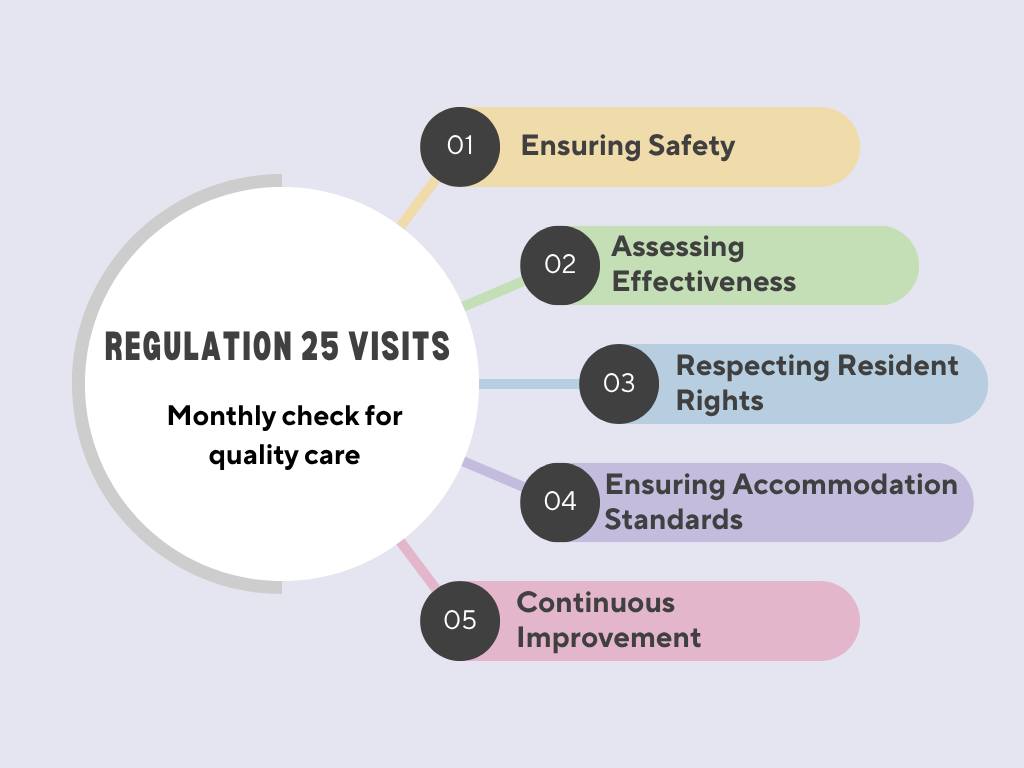
A Regulation 25 visit is a monthly inspection of a residential family centre carried out by, or on behalf of, the registered provider. Its purpose is to check that the care, accommodation, and support being provided are safe, effective, and respectful of residents’ rights (Ofsted, 2025).
The visit is named after Regulation 25 (Visits by registered provider) of the Residential Family Centres Regulations 2002, which sets out exactly who must visit, how often, and what the visitor must do. The regulation is part of a wider quality‑assurance system, Regulation 23 requires the provider to review the quality of care at appropriate intervals, and Regulation 25 provides a regular, on‑the‑spot check that those reviews are accurate.
2. Who can conduct a Regulation 25 visit?
The regulations are clear about who may carry out the visit. If the registered provider is an individual who is not in day‑to‑day charge of the centre, they must personally visit. If the provider is an organisation or partnership, the visit must be made by:
- the “responsible individual” (a director or partner), or
- another director or person responsible for the management of the organisation, or
- an employee of the organisation who is not directly concerned with the conduct of the centre (Regulation 25(1‑3)).
Many providers choose to commission an independent social worker or specialist agency to carry out the visit on their behalf. This independence is valued by Ofsted because it brings an impartial perspective and helps identify issues that an internal person might miss (Aspire, 2024; Aidhour, 2026).

3. What happens during a Regulation 25 visit?
The regulation specifies the minimum activities. The visitor must:
- Interview residents and staff – with their consent and in private – to form an opinion of the standard of care (Regulation 25(4)(a)).
- Inspect the premises, including the physical environment, safety equipment, and the centre’s records (Regulation 25(4)(b)).
- Prepare a written report that assesses the conduct of the residential family centre (Regulation 25(4)(c)).
In practice, a good visit goes further. Independent social workers often review case files, speak with family members (including children, where appropriate), and check that the centre is meeting the Residential Family Centres National Minimum Standards .
4. How often must a Regulation 25 visit occur?
A visit must take place at least once a month and may be unannounced (Ofsted, 2025). This frequency ensures that problems are detected early and that standards do not slip between formal Ofsted inspections (which occur roughly every three years). The registered provider must send the written report to Ofsted by the end of the following month, even if no families are living in the centre at the time of the visit. The report must include Ofsted’s unique reference number (URN) and the date of the visit.

5. What does Ofsted do with the reports?
Ofsted reviews every Regulation 25 report it receives. The reports help inspectors:
- Monitor the safety, well‑being, and progress of children and parents between inspections
- Identify themes or patterns of concern
- Track whether previous recommendations have been acted upon
- Decide whether to bring forward an inspection or conduct a follow‑up visit (Ofsted, 2025)
In short, the Regulation 25 report is not a “tick‑box” exercise. It is a live document that contributes directly to the centre’s Ofsted judgement and can be the trigger for enforcement action if serious problems are found.

6. Cost of hiring an independent visitor
There is no single fixed price for a monthly Regulation 25 visit. Costs vary between providers, regions, and the visitor's qualifications. A BASW survey indicated that independent social workers in the UK typically charge between £25 and £80 per hour. A complete visit, including travel, an inspection of the centre and its records, and a detailed written report, is usually quoted as a day’s work; at a representative day‑rate, a single visit may fall in the region of £280–£560, though fees may be higher depending on the visitor’s experience and any additional governance reports included.
Because prices are not standardised, it is advisable to contact a specialist agency directly for a tailored quote. Providers known to offer Regulation 25 services include Aspire (aspiresocialwork.co.uk) and Aidhour (aidhour.co.uk), as well as WillisPalmer (willispalmer.com). Each of these will be able to discuss your centre’s specific requirements and provide a transparent quote.

7. Is it always the same person?
The regulations do not require the same individual to visit every month. However, continuity is beneficial: a visitor who knows the centre’s history, staff, and families can spot subtle changes and follow up on previous recommendations more effectively (Aspire, 2024). Many centres therefore build a long‑term relationship with one independent social worker or a small team from the same agency. The key statutory requirement is that the visitor must be independent—i.e., not directly involved in the day‑to‑day running of the centre (Regulation 25(3)(c)).
8. Example of a Regulation 25 report
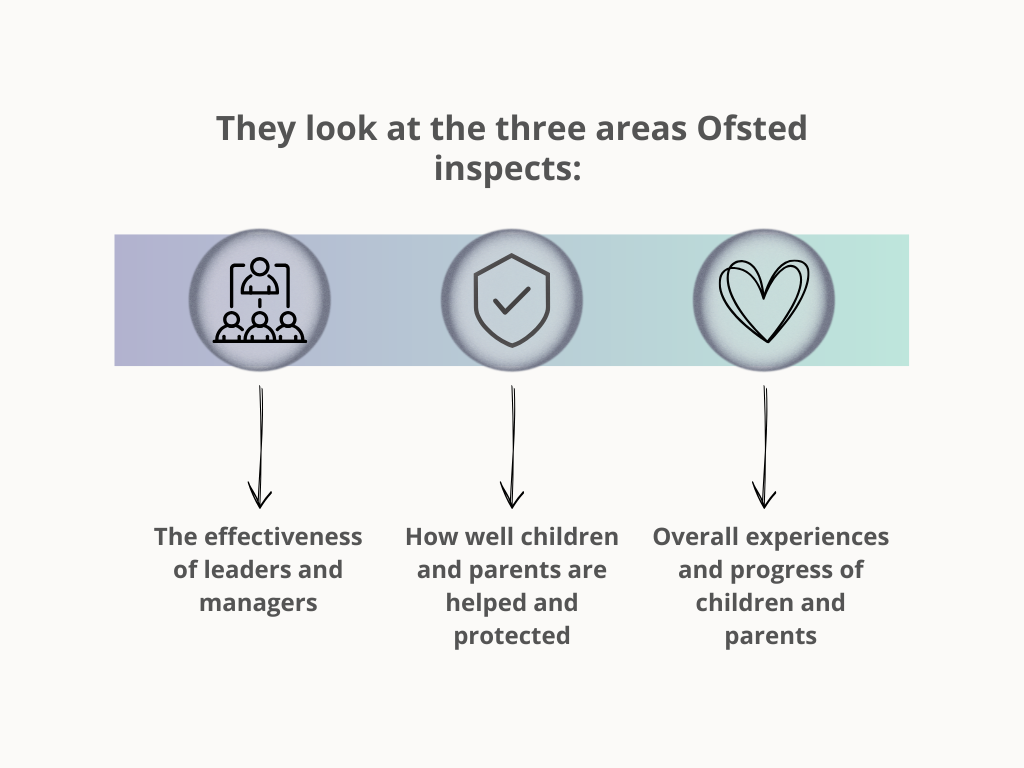
While Ofsted does not publish a standard template, most reports follow a structure aligned with the three Ofsted inspection domains. A typical anonymised report might include:
- Header – Centre name, URN, date of visit, visitor’s name.
- Introduction – Purpose of the visit, whether it was announced or unannounced.
- Methodology – Who was interviewed, which records were reviewed, which areas of the premises were inspected.
- Findings – Strengths and areas for development, organised under the three Ofsted domains:
- Overall experiences and progress of children and parents
- How well children and parents are helped and protected
- The effectiveness of leaders and managers
- Recommendations – Specific, measurable actions the centre should take.
- Conclusion – Summary of the overall conduct of the centre.
- Signatures – Visitor and, where appropriate, the registered manager.
9. How FamilyAxis assists with the Regulation 25 process
Residential family centres are moving towards paperless working, and purpose‑built software can dramatically simplify the Regulation 25 process for both the centre and its independent visitor. As we’ve discussed on the FamilyAxis blog, fragmented systems often force staff to spend more time on administration than on direct work with families (FamilyAxis, 2026).
The new Auditor role in FamilyAxis
To support centres and their independent visitors, FamilyAxis now includes a dedicated Auditor role. This role allows the visitor to:
- View all data that is relevant to the visit, case records, daily logs, incident reports, maintenance records, without being able to make any changes.
- See only the information that is necessary for the visit; confidential records that the visitor does not need to see are automatically hidden.
- Access the centre’s data securely from any location, reducing reliance on paper files and making it easier to prepare for, conduct, and write up the visit.
This read‑only, role‑based access is designed to meet the statutory requirement for independence while giving the visitor everything they need to produce a thorough, Ofsted‑ready report.

Conclusion
A Regulation 25 visit is much more than a statutory hoop to jump through. It is a vital safeguard that protects vulnerable families and drives continuous improvement in residential family centres. By understanding the legal requirements, choosing skilled visitors, using the reports proactively, and adopting purpose-built software, providers can meet Ofsted’s expectations. More importantly, these steps build a culture of excellence that benefits every parent and child they support.
Help us shape the future of FamilyAxis
At FamilyAxis, we are committed to building software that genuinely supports residential family centres and their independent Regulation 25 visitors. If you are a centre with ideas on how we can make the auditor role, or any other feature,even more useful, we would love to hear from you. Your on‑the‑ground experience is the best guide we have. Please get in touch and help us build tools that work for you.
References
- Aidhour (2026) Regulation 25 Visits to Residential Family Centres. Available at: https://www.aidhour.co.uk/regulation-25-visits
- Aspire (2024) Professional Visiting and Reporting Service. Available at: https://www.aspiresocialwork.co.uk/professional-visiting-and-reporting-service/
- BASW (2023) Residential Family Centres: National Minimum Standards. Available at: https://new.basw.co.uk/policy-and-practice/resources/residential-family-centres-national-minimum-standards
- BASW (2023) ‘Independent social workers hit out at Ministry of Justice’, BASW News, 15 November. Available at: https://basw.co.uk/articles/independent-social-workers-hit-out-ministry-justice
- FamilyAxis (2026) Best Software for Family Assessment Centre Documentation. Available at: https://familyaxis.com/blog/choosing-software-for-a-residential-family-centre-what-actually-matters
- Ofsted (2023) Social Care Common Inspection Framework (SSCIF): residential family centres. Available at: https://www.gov.uk/government/publications/social-care-common-inspection-framework-sccif-residential-family-centres
- Ofsted (2025) Responsibilities of providers and managers in Ofsted‑registered residential family centres. Available at: https://www.gov.uk/government/publications/register-a-residential-family-centre/responsibilities-of-providers-and-managers-in-ofsted-registered-residential-family-centres
- The Residential Family Centres Regulations 2002, SI 2002/3213. Available at: https://www.legislation.gov.uk/uksi/2002/3213/contents/made
This article was written for familyaxis.com and is intended as general guidance only. Providers should always refer to the latest legislation and Ofsted guidance and, where appropriate, seek independent legal advice.