



Social CareDigital Transformation in Children's Social Care: What the 2026 LGA Report Tells Us

· 7 min read
Where is children's social care on its digital journey? A new national survey from the Local Government Association and the Department for Education shows genuine progress in AI and analytics, alongside a reliance on manual processes. The findings hold useful lessons for any team thinking about how technology can support the work.
Digital transformation is becoming increasingly important across children's social care. Technology has the potential to reduce administrative work, improve access to information, support better decision-making and help services run more effectively.
But digital transformation is not simply about introducing new technology. It is also about how well organisations use data, how systems work together, whether staff have the right tools and skills, and whether technology is designed around the needs of the people using it.
A new report from the Local Government Association (LGA), produced in partnership with the Department for Education, provides a snapshot of where children's social care currently stands. Data and digital maturity in children's social care, published in July 2026, is based on a national survey of local authorities in England. Of the 151 authorities invited to participate, 110 responded, a response rate of 73%. The research examined digital maturity across five areas of practice.
Key takeaways
- Digital maturity is about more than software: data practices, governance, skills and service design all matter.
- Manual processes still dominate: 71% of authorities receive safeguarding data as email attachments, while only 25% use an API connection.
- AI is racing ahead of governance: 79% of authorities use AI, but just 4% have a children's-services-specific AI strategy.
- Frontline recording varies widely: half of authorities allow direct input into systems, while a third still transfer records retrospectively.
- Leadership ambition outpaces resources: 80% of leaders push for better use of data and technology, but only 59% of authorities have the resources to act.

What does digital maturity mean in children's social care?
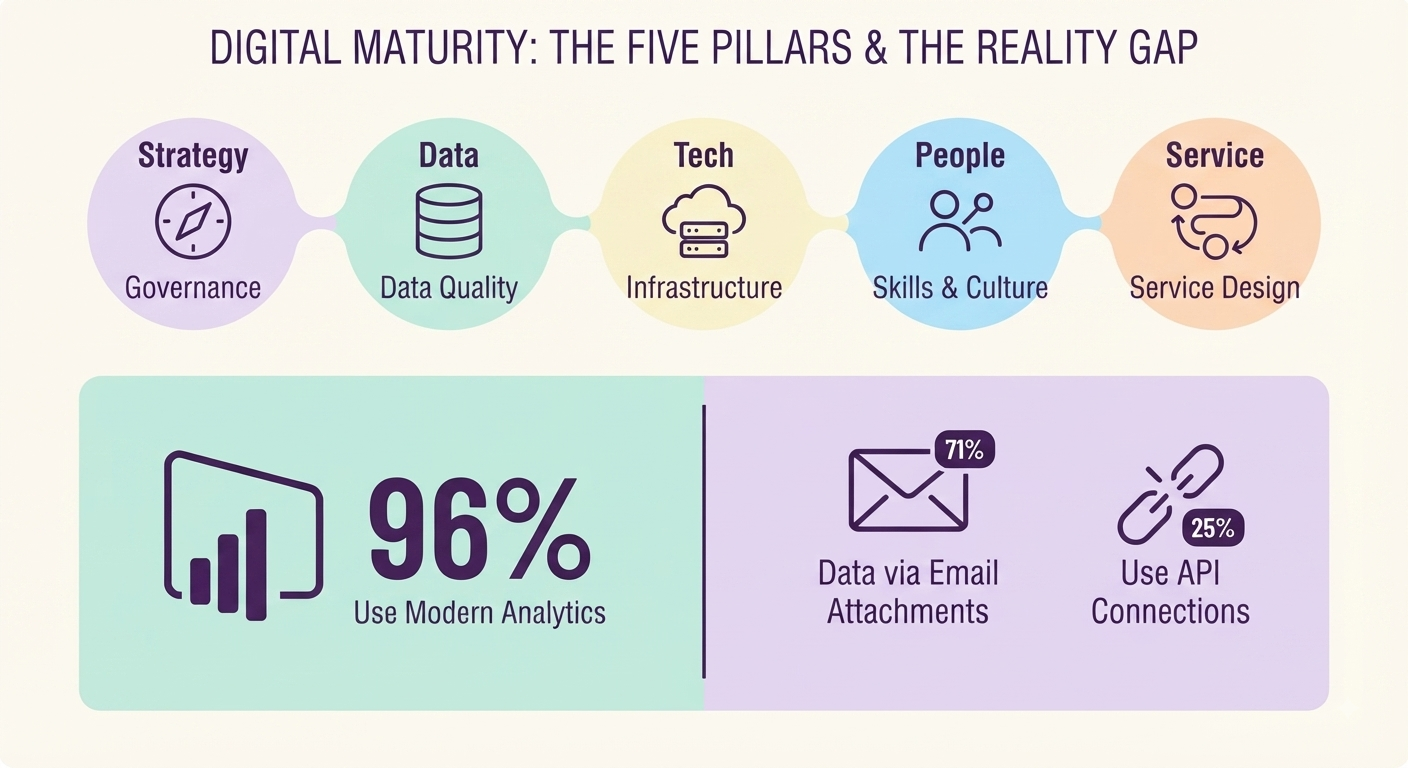
The report does not define digital maturity simply in terms of which software an organisation uses. Instead, it considers five pillars:
- Strategy and governance
- Data management and quality
- Technology and infrastructure
- People, skills and culture
- Service design and use of data, digital and technology
This matters because an organisation can have sophisticated technology while still relying on manual processes elsewhere. The report provides a clear example: almost all responding authorities (96%) use Power BI for reporting and analysis, yet 71% receive safeguarding data from external partners as email attachments, and only 25% use an API connection.
In other words, having modern analytical tools does not mean the underlying processes are digitally mature.
The challenge of reducing manual work
The survey highlights a continuing reliance on manual processes. This matters because manual processes can mean duplicating information, transferring records between systems and spending time on administration instead of frontline work.
The findings on social worker recording are particularly relevant. Half of authorities said social workers can record information directly into systems while on location. However, 32% said staff have to transfer information to case management systems retrospectively, and 17% said social workers collect information and enter it manually later.
The same problem appears wherever information has to move. A social worker re-enters notes by hand because their tools don't connect to the case management system. A centre prints, scans and emails a report because the systems on either side can't share it directly. Information recorded once gets recorded again, at every handoff.
This raises a question for technology providers:
How can we work together rather than compete, so the tools we build for children's social care are compatible with each other?
Multi-agency collaboration is at the heart of social work, and information needs to move between organisations, not get stuck in systems that work in isolation. Technology should fit the way professionals work, not add steps around the work.

AI is developing rapidly, but governance needs to keep up
One of the most striking findings is the speed of AI adoption. 79% of authorities reported using AI for work, tasks or processes. Among those, 95% use Microsoft Copilot, and 53% use Beam: Magic Notes, a tool designed specifically for children's social care.
The governance gap is significant. Only 4% of authorities have an AI strategy specific to children's services. A further 38% have a whole-authority AI strategy, 46% are still developing one, and 74% already have AI usage guidance for staff.
Adoption is clearly moving faster than the governance frameworks around it. In a field where information is highly sensitive and decisions have significant consequences for children and families, responsible implementation matters. But it is also genuinely difficult. Children's services teams are notoriously time poor, and unlike larger organisations with dedicated compliance teams, they may not have the resources to hire people whose only job is to explore technology and put safety measures in place
Building the strategy, the training and the safeguards around AI while still doing the day-to-day work of keeping children safe is a lot to ask of any team. The gap between adoption and governance is not a sign that people do not care. It is what happens when a stretched sector is expected to keep up with technology moving at full speed.

Data sharing remains a major challenge
The report identifies incompatible systems, inconsistent use of unique identifiers and limited staff capacity as the main barriers to sharing data, both with external partners and within councils.
Out-of-area agreements tell the story: only 5% of authorities have data-sharing agreements with all out-of-area partners, 53% have them with some, 17% have none, and 25% do not know whether agreements exist.
Digital maturity is therefore not only about what happens inside one organisation. It also depends on how well information moves between the organisations involved in supporting children and families.
What does this mean for residential family centres?
A residential family centre is a home-like setting within children's social care where families live together or in self-contained apartments while their parenting is assessed. Parents and children stay on site, supported by staff, while their day-to-day care is observed. Those observations feed into the assessments and reports that help courts and local authorities decide what is best for the child.
There is a lot to coordinate: parenting assessments, risk assessments, audits, alongside the day-to-day running of the centre and workforce requirements like training, supervision and compliance.
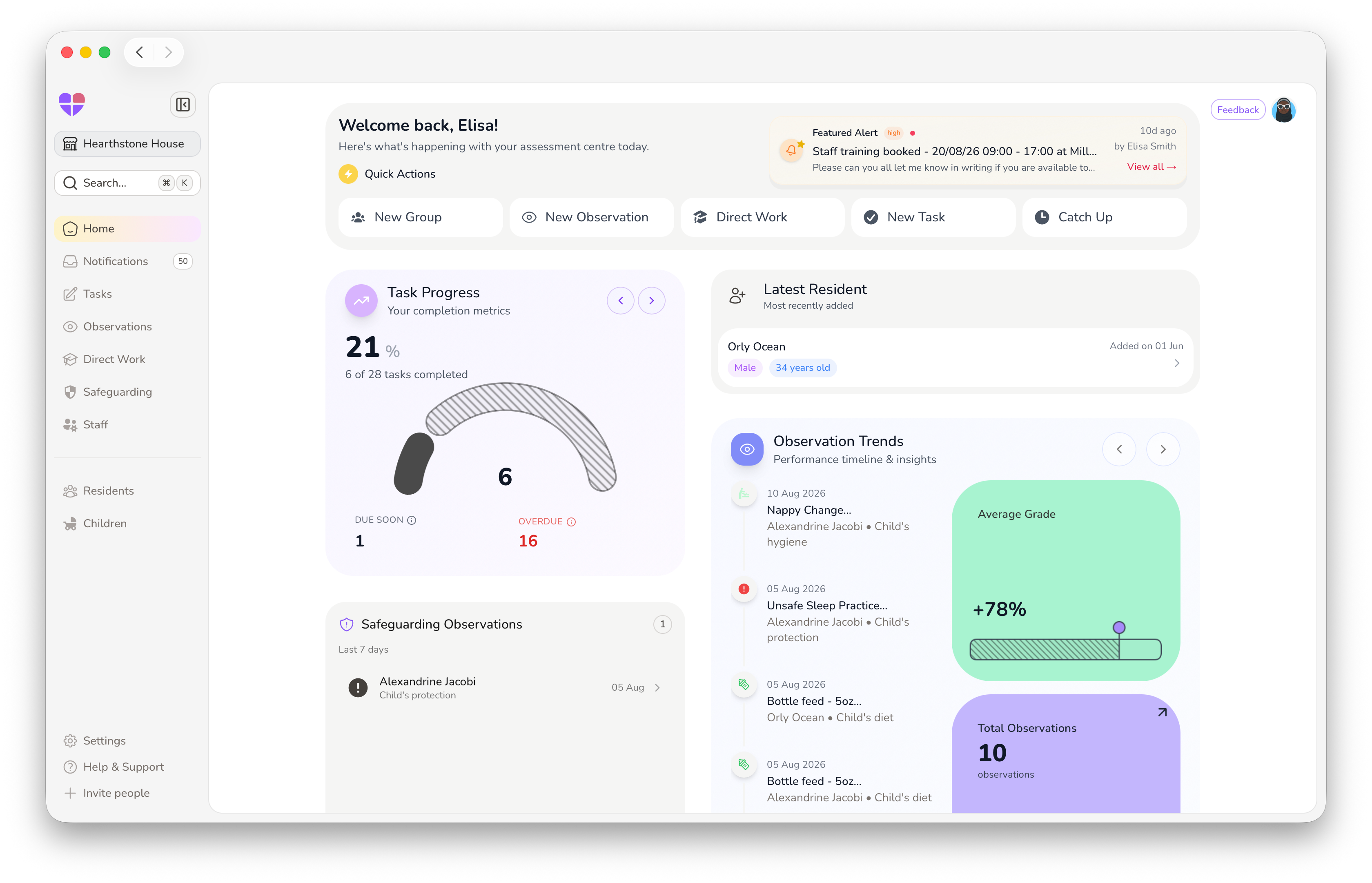
Anyone who has worked in a centre will recognise the report's picture of manual processes and disconnected systems. The same information typed once, transferred again, and hunted for later. That is part of the reason we built FamilyAxis, a platform designed specifically for residential family centres, bringing assessments, observations, safeguarding, reports, tasks and staff management into one place.
The report's core message is that digital maturity is not about which software you buy. It is about whether the technology fits the work. That is what purpose-built software is for: understanding the job first, then building the tool around it.
Digital transformation should start with the problem
The findings suggest the next stage of digital transformation is about using technology appropriately to address real operational challenges: reducing duplication, making information easier to access, improving how records are captured, supporting better reporting and sharing among different agencies. Software is only one part of digital maturity, though. Leadership, governance, staff skills, data quality and service design all matter. The survey found that 80% of authorities said their leadership teams encourage better use of data, digital and technology, but only 59% have the resources or support to act on it.
None of this is easy, especially in a sector that is notoriously time and resource poor. That gap between ambition and implementation is a useful lesson for any organisation considering digital transformation. For FamilyAxis, it means building technology specifically around the requirements of residential family centres. As the sector develops its digital maturity, purpose-built technology has a real role in helping services move from simply having digital tools to using them in ways that genuinely support better practice.
If you work in social care tech and see potential for our platforms to complement one another, let's connect. It is our collective responsibility to collaborate and help dismantle the barriers highlighted in this report and article.
Sources
- Government Social Research. (2026). Data and digital maturity in children’s social care Findings from a national survey of local authorities. Department for Education. Retrieved August 11, 2026, from https://assets.publishing.service.gov.uk/media/6a6893a583f71b8684d020de/Data_and_digital_maturity_in_children_s_social_care.pdf