



Social CareWriting Court-Ready Reports: Minimising Subjectivity in Parenting Assessments

· 12 min read
Are your observation notes recording what actually happened, or what you think happened? A practical guide for teams working in residential family centres on keeping observation separate from opinion, building a clear evidence trail, and writing reports that hold up in court. The article also introduces the tools we have built at FamilyAxis to make this easier, keeping every observation linked to the final report so nothing gets lost along the way.
Why I Still Think About My First Observation Logs
I still remember the first set of observation notes I wrote, knowing they would end up in a court report. I re-read them more times than I can count, and talked it through at length with a colleague, lucky enough that it was a quiet night shift and we had the time. I worried about whether I had been fair to the parent, whether I had captured the child's experience, and whether it was written in a way that would actually hold up in court.
That anxiety is normal. The logs and assessments written in residential family centres are read by parents, their solicitors, guardians, judges, and sometimes the child in years to come. The pressure to "get it right" can tempt us to sound more certain than the evidence really allows. Over time, I learned that the most defensible records are not the ones that sound the most forceful; they are the ones that make it crystal clear what was seen, what was heard, and what professional conclusion was drawn from it.

I'll be honest, I sometimes wonder if I'm even qualified to write an article like this. I was never a social worker. But I worked for a fantastic residential family centre that trained me well, alongside inspiring professionals I learned enormously from, and I studied psychology, which gave me a framework for understanding why we get things wrong even when we are trying our best. It's that combination, practical experience and academic grounding, that I'm drawing on here.
This guide is written for anyone involved in producing court-evidenced records in a residential family centre, whether you are a practitioner newer to the work or an experienced worker looking for better tools to support you and your team. It is about keeping subjectivity out of your reporting. It is also part of why I eventually left direct work with families to build a tool for this sector. I felt, and still feel, that the people doing this work deserve better tools to support it.
Key takeaways
- Separate observation (what you saw or heard) from inference (what you think it means).
- Use direct quotes and contemporaneous notes rather than summaries made from memory.
- Avoid loaded adjectives and absolute language such as "always," "never," or "manipulative."
- Objectivity does not mean being cold; professional analysis is still required, but it must be clearly signposted.
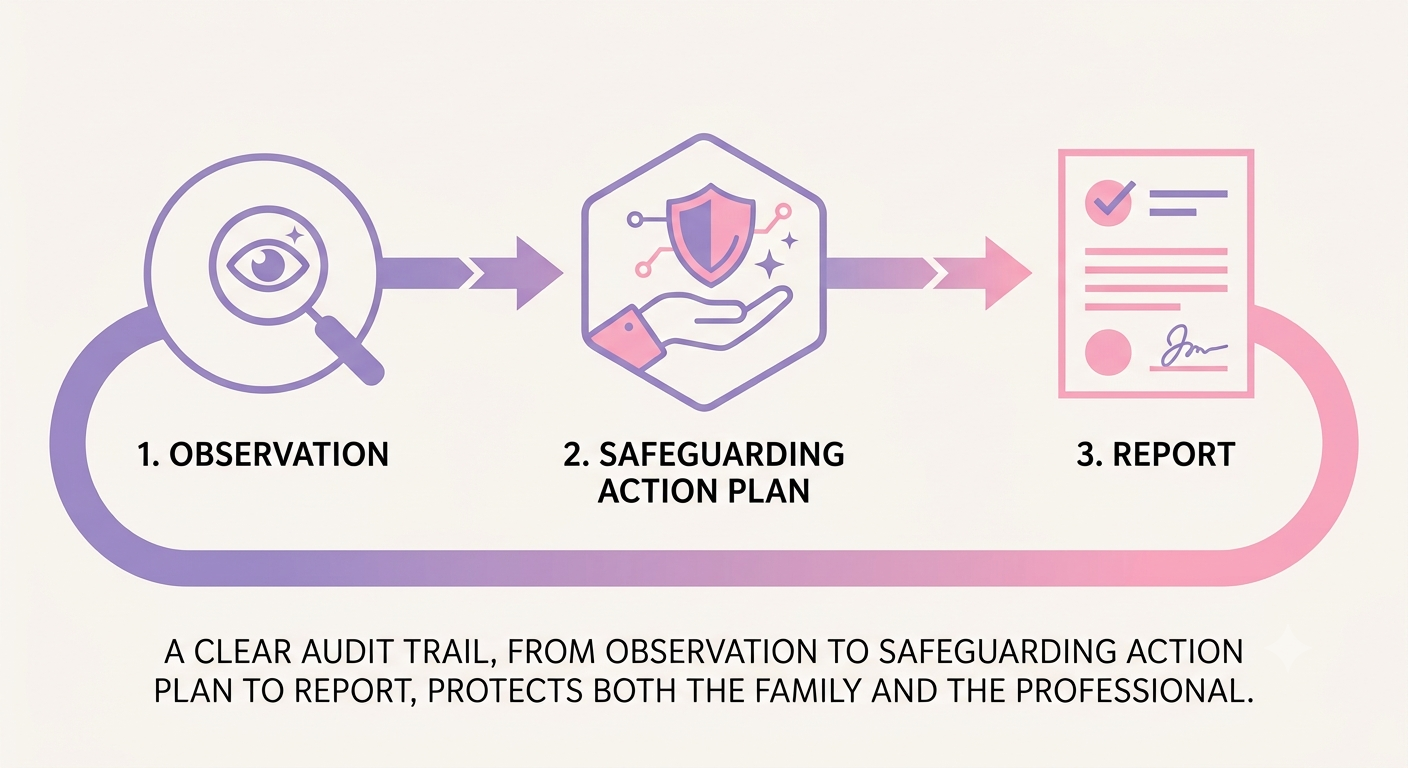
- A clear audit trail, from observation to safeguarding action plan to report, protects both the family and the professional.
1. Why objectivity matters in court reports
A parenting assessment report is not an internal case note. Reports that end up in court bundles must distinguish clearly between verified facts, allegations made by the adults, hearsay evidence, and the practitioner's own assessment, analysis, or opinion. This is a fundamental requirement of court-evidenced reporting: the court needs to know what is established fact, what is contested, and what is professional judgement. The same standard applies to the reports produced by residential family centres, because they often end up in the same court bundles as those from other agencies.
Reports should also be succinct, relevant, and non-repetitive, and written in plain English so they are understandable to the parent as well as to the court. That matters. A parent who can read and follow your evidence is more likely to feel the process was fair, even if they disagree with the outcome.
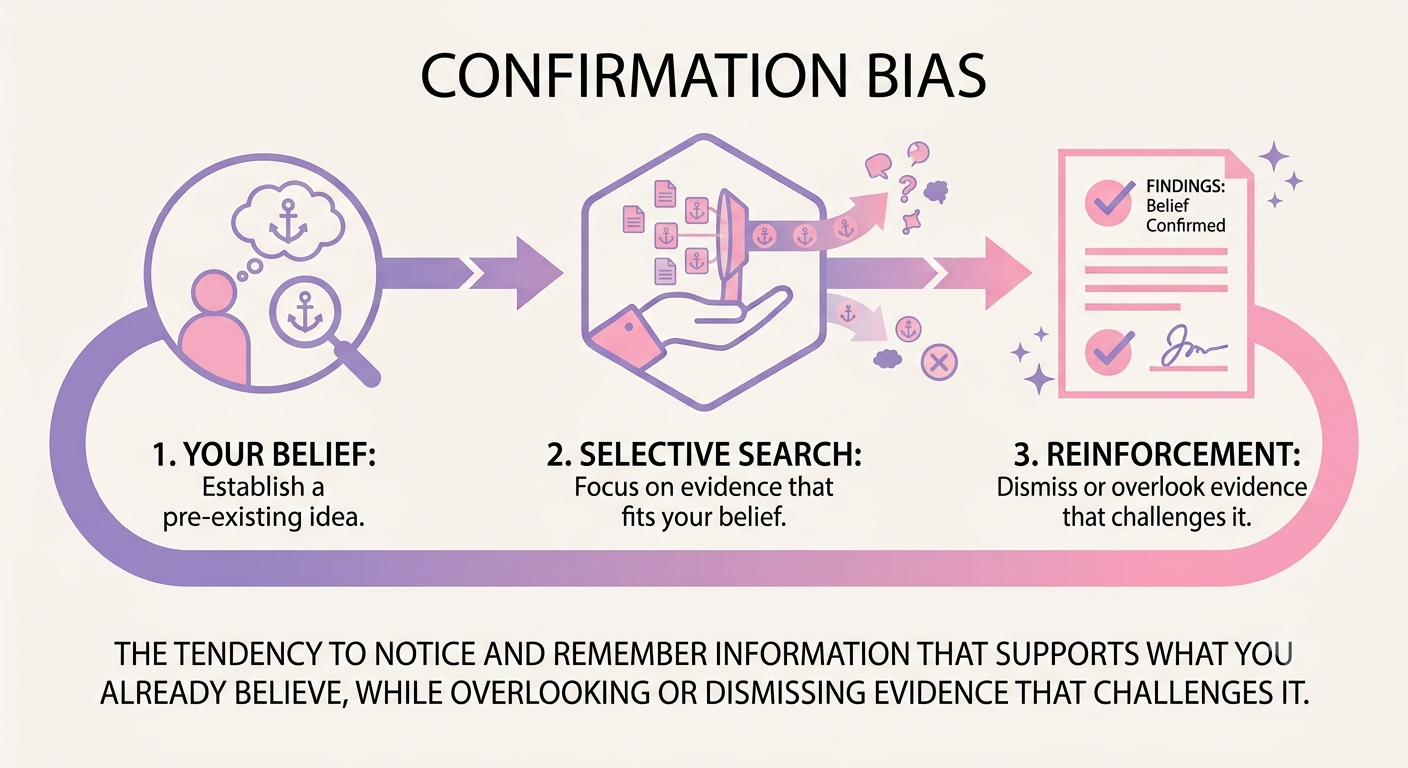
Research into social work decision-making confirms that practitioners are vulnerable to the same cognitive biases as everyone else: confirmation bias, the availability heuristic, and the affect heuristic. In other words, once we form a view about a parent, we tend to notice information that supports that view and filter out information that does not. Munro (1999) identified common errors of reasoning in child protection work, demonstrating that professionals are not immune to these patterns of thinking. Objectivity is not a personality trait; it is a discipline we build into how we record and review information.
2. Observation versus inference: the core skill
A frequent mistake in early observations is jumping from an observation straight to a label.
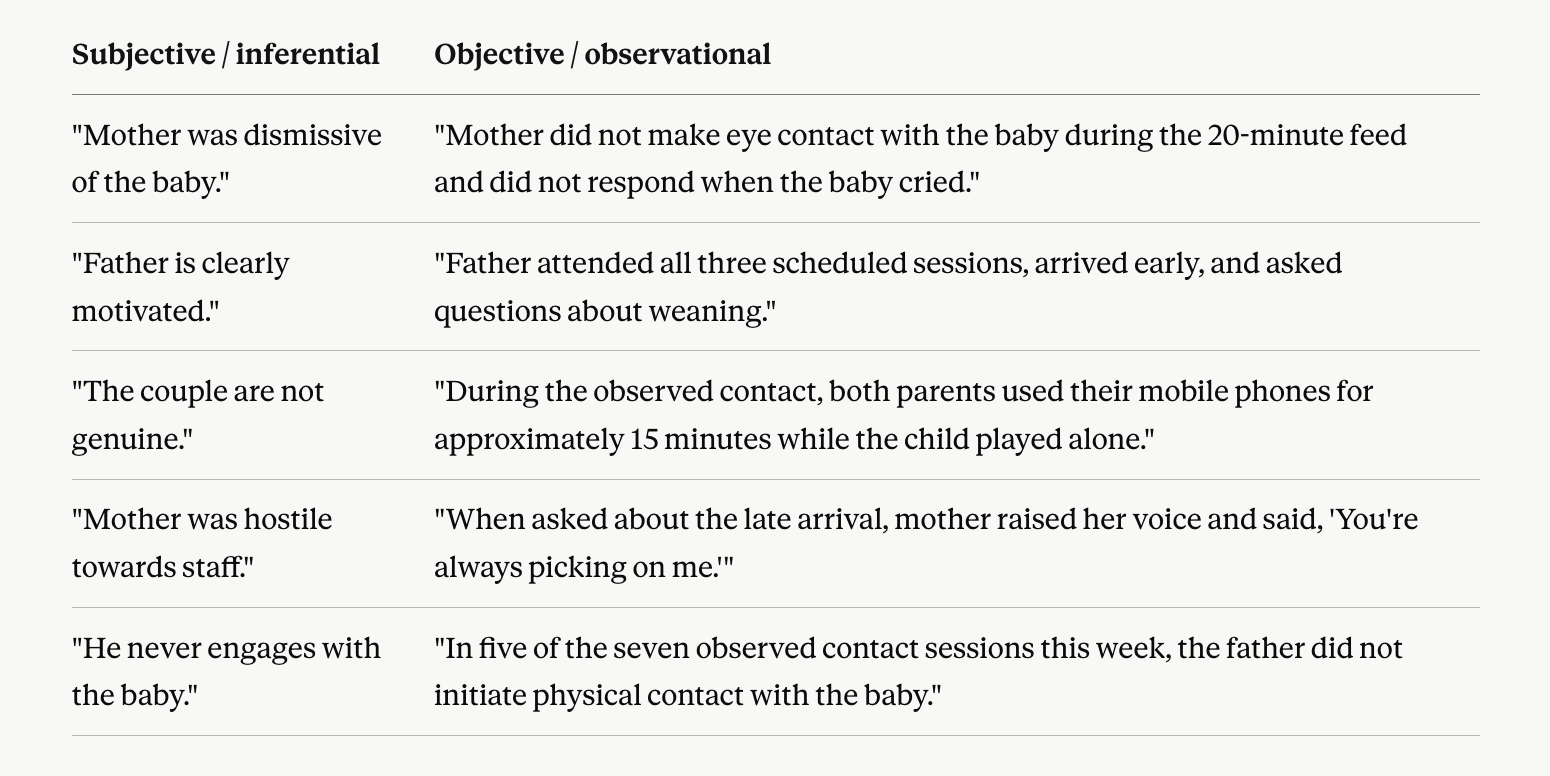
The first column sounds decisive, but it does not tell the reader what actually happened. The second column gives them the evidence and lets them, and the court, draw their own conclusion. That balance starts with separating what you saw from what you think it means.
3. Common traps that let subjectivity creep in
Loaded adjectives. Words like "manipulative," "hostile," "evasive," or "disengaged" carry judgement. They are sometimes accurate, but they must be anchored to specific behaviour. For example, instead of writing "Mother was manipulative," record: "Mother told staff she had not eaten for two days; when offered a meal, she declined, saying she had already eaten." The behaviour is now visible to the reader.
"Always" and "never." Unless you have observed every interaction, these words are rarely defensible. "The parent often arrives late" is more accurate than "The parent is always late."
The halo and horns effect. If a parent is warm and cooperative, it is tempting to grade everything positively. If they challenge us, the opposite can happen. This cognitive bias, known as the halo and horns effect, leads us to let one positive or negative trait colour our judgement of everything else (Munro, 1999). Helm and Roesch-Marsh (2016) describe professional judgement as an "ecology" shaped by individual perception, team culture, and organisational pressure. Good centres guard against this by using structured observation frameworks, peer discussion, and supervision.

4. What "objective" does not mean
Objectivity is not the same as being cold or withholding professional judgement. Parents in residential centres are often frightened, ashamed, or angry, and reports should be respectful of that. Munro (2011) supported this by arguing that good child protection depends on professional expertise and relationship-based practice, not just box-ticking.
The point is to be transparent about where the evidence ends and your professional analysis begins. For example:
"During three observed feeds, the mother consistently turned the baby away from her body and finished each feed within four minutes. In my professional view, this limits the opportunity for attuned interaction, which is a concern given the child's young age."
The first sentence is observation. The second is analysis. Both are needed, but they should not be blurred.
5. Practical techniques for objective recording
Write soon after the event. Details fade quickly, and memory is reconstructive. Contemporaneous logs are stronger evidence than notes written the following day.
Use direct quotes. A parent's own words are harder to challenge than your paraphrase. Rather than "She seemed angry about the referral," record her words: "She said, 'This is just social services picking on me again, isn't it?'" Quote selectively and accurately.
Watch CCTV back when you can. During my psychology degree, I learned how unreliable our brains truly are. One habit I found invaluable as a practitioner was reviewing CCTV footage of significant events before finalising my notes. Watching a critical interaction again can reveal details you missed or correct an impression that memory distorted. I quickly learned that what I thought I had seen was not always what happened. Research confirms that memory is malleable and vulnerable to suggestion (Schacter, 1999); reviewing video evidence is one practical way to keep your records factual.
Record the context. Where were you? What time of day? Who else was present? What was the child doing? Context helps the reader assess proportionality.
Separate fact from opinion in your head before it reaches the keyboard. Ask: "If I had to prove this in court, what evidence would I point to?"
Discuss it with your team. When you are unsure or new to the work, talking things through with your colleagues is one of the best ways to check your own bias. It is much harder to spot your own blind spots than it is for someone else to see them. In a residential family centre, your team knows the case, and that shared knowledge is a strength, not a weakness. A colleague can flag loaded language or an unsupported conclusion that you have stopped noticing. Experienced practitioners may use intuition as a starting point for assessment, but those who avoid bias are the ones who then subject that intuition to scrutiny, testing their impressions against the recorded evidence and inviting challenge from peers.

6. The golden thread: from observation to report
One of the most useful ways I have found to explain good recording to new colleagues is the idea of a golden thread. A single observation should be traceable all the way through to the final report.
- An observation is recorded: what was seen or heard, when, and by whom.
- It is graded using a consistent scale, so the level of concern is transparent.
- If it reaches a safeguarding threshold, it triggers a safeguarding action plan that sets out what happens next.
- When a report is compiled, the author can select which observations and direct-work sessions support the analysis.
- The final report shows the evidence, the professional analysis, and the audit trail behind it.
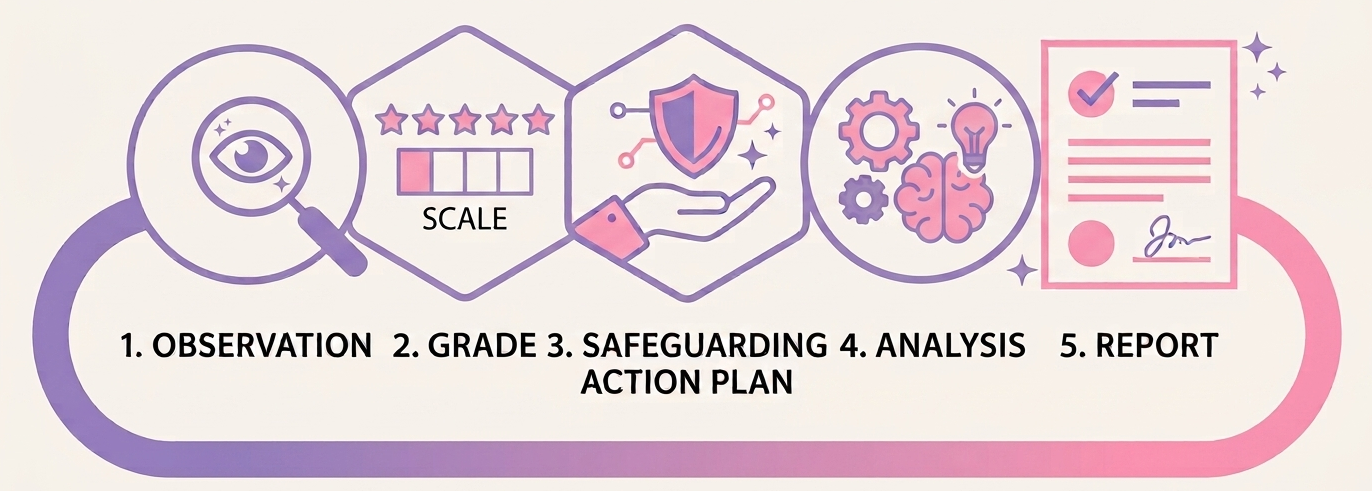
This matters because a court-ready report is more than a final document. It is the endpoint of a process that should be visible and reviewable at every stage. The best reports are "forensic in method", the reader can track the key issues from the background, through the assessment, to the conclusions and recommendations. That is only possible if the original evidence has been recorded clearly and consistently throughout.
The Wandsworth Children's Services Practice Handbook reflects this same principle from a local authority perspective, noting that assessments should be accessible and transparent, and that practitioners should ensure accurate and proportionate information sharing throughout the life of a case (Wandsworth Children's Services, 2021).
7. How our tools support this workflow
As co-founder of FamilyAxis, my role was to translate what I had lived through into something the development team could build. I was not the one writing code; I was the one explaining why the golden thread mattered, because I had experienced first-hand the scattered evidence, the worry about whether I had recorded the correct information in the right place, and the struggle to find it again when it mattered most.
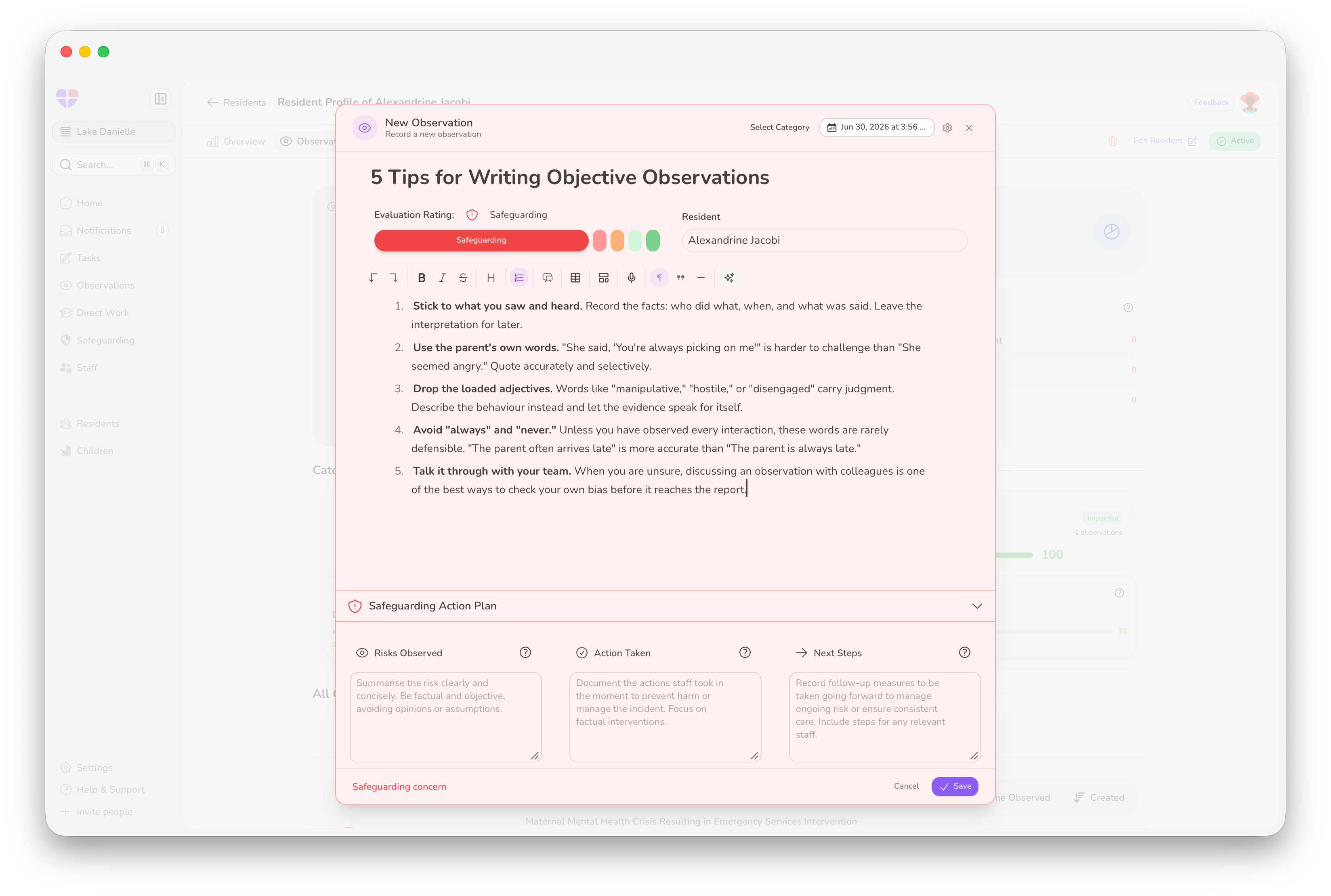
What we built together keeps that thread intact. When a staff member logs an observation, they record what was seen and heard, grade it on a consistent scale, and, if it reaches safeguarding threshold, the system prompts a safeguarding action plan. The original observation stays linked to that plan, so the decision about what to do next is always tied to the evidence that triggered it.
When it is time to compile a court report, the report builder pulls those observations and direct work logs into one place. As we noted earlier, court reports should be succinct and non-repetitive. The tool lets you review all recorded observations and select only the ones that are relevant to the assessment, rather than copying everything in. You add your professional analysis in structured text blocks, and the final document is saved with a unique ID and date stamp.
This does not write the report for you, and it should not. What it does is keep everything in one place, so that a new member of staff, or a manager reviewing the file, can follow the path from a single observation to the final assessment without hunting through different systems. That is what I wished I had when I was doing this work.
Conclusion
No software can make your observations objective. That depends on the training and experience of the people writing them: the habit of separating observation from inference, the willingness to record uncomfortable facts fairly, and the humility to let the evidence lead the conclusion rather than the other way round.
But the right tools, and the right techniques, like using direct quotes, recording context, and asking a colleague to review your work, can make that discipline easier to maintain, especially in busy residential centres where staff turnover is high and new team members need to get up to speed quickly. If this article helps one new worker write an observation that is clear, fair, and evidence-led, then it has done its job.
Glossary: Key Cognitive Biases
Confirmation bias. The tendency to notice and remember information that supports what you already believe, while overlooking or dismissing evidence that challenges it. In practice, once you form a view about a parent, you may unconsciously filter everything you observe to fit that view.
Availability heuristic. The tendency to judge what is likely or important based on what comes to mind most easily; usually things that are recent, vivid, or emotionally striking. A single dramatic incident can therefore outweigh weeks of steadier evidence in shaping your assessment.
Affect heuristic. The tendency to let emotional reactions, how a situation or person makes you feel, guide your judgements, sometimes without realising it. Sympathy towards a parent may unconsciously minimise your concerns, while feeling intimidated may inflate them.
Sources
- Casad, B. J. (2026, June 11). Confirmation bias. Encyclopaedia Britannica. Retrieved June 26, 2025, from https://www.britannica.com/science/confirmation-bias
- Helm, D. & Roesch-Marsh, A. (2016). The ecology of judgement: A model for understanding and improving social work judgements. British Journal of Social Work, 46(5), 1099–1116. https://doi.org/10.1093/bjsw/bcv113
- Munro, E. (1999). Common errors of reasoning in child protection work. Child Abuse & Neglect, 23(8), 745–758. https://doi.org/10.1016/S0145-2134(99)00053-8
- Munro, E. (2011). The Munro review of child protection: Final report — A child-centred system (Cm 8062). Department for Education. https://www.gov.uk/government/publications/munro-review-of-child-protection-final-report-a-child-centred-system
- Schacter, D. L. (1999). The seven sins of memory: Insights from psychology and cognitive neuroscience. American Psychologist, 54(3), 182–203. https://doi.org/10.1037/0003-066X.54.3.182
- ScienceDirect. (2001). Availability heuristic [AI-generated topic overview based on International Encyclopedia of the Social & Behavioral Sciences]. Retrieved June 26, 2025, from https://www.sciencedirect.com/topics/computer-science/availability-heuristic
- ScienceDirect. (2018). Affect heuristic [AI-generated topic overview based on False Allegations]. Retrieved June 26, 2025, from https://www.sciencedirect.com/topics/psychology/affect-heuristic
- Wandsworth Children's Services. (2021). Wandsworth Children's Services practice handbook. https://proceduresonline.com/trixcms2/media/9250/047_wandsworth-csc-practice-handbook-v18.pdf