



Social CareA Guide to Section 47 of the Children Act 1989

· 8 min read
How do local authorities investigate concerns that a child is suffering, or is likely to suffer, significant harm? This article provides a detailed guide to Section 47 of the Children Act 1989, explaining the legal framework, the enquiry process, and the potential outcomes for children and their families.
What happens when concerns about a child's safety go beyond needing extra support? When do professionals move from offering help to launching a formal investigation?
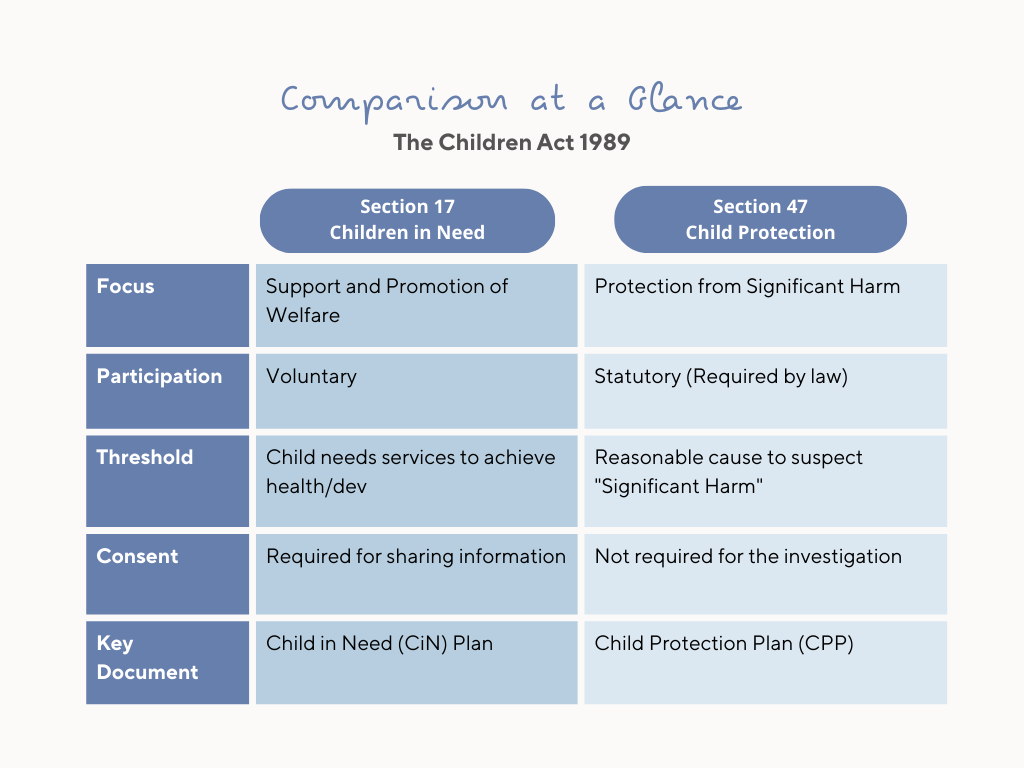
These are the questions at the heart of Section 47 of the Children Act 1989. While its counterpart, Section 17, focuses on providing voluntary support to "children in need," Section 47 is the legal mechanism that kicks in when those needs escalate into something more serious, specifically the risk of significant harm.
So, what does this mean in practice? Under Section 47(1), if a local authority has
reasonable cause to suspect that a child who lives, or is found, in their area is suffering, or is likely to suffer, significant harm,
they are legally required to make enquiries. Their goal is to determine whether they need to take action to safeguard and promote that child's welfare. This duty doesn't only apply to new concerns. It is also triggered automatically if a child is already subject to an Emergency Protection Order or is currently in police protection.
Importantly, the local authority leads this process, and the investigation must be headed by an experienced social worker. It is a serious undertaking, but one designed with an important purpose: to find out the truth and, where needed, protect a child from harm.
Key Takeaways
- A duty to investigate. Section 47 requires local authorities to make enquiries when a child is suspected to be at risk of significant harm.
- The threshold is suspicion, not proof. The bar is "reasonable cause to suspect," not confirmed evidence.
- It's a team effort. Other agencies have a legal duty to assist the local authority with their enquiries.
- Timing matters. The whole assessment must be completed within 45 working days. If a child protection conference is needed, it happens within 15 working days of the strategy discussion.
How the Section 47 Process Unfolds
1. The Strategy Discussion: Where It All Begins
A Section 47 enquiry doesn't just happen in a vacuum. It starts with a strategy discussion, a meeting or series of conversations involving Children's Social Care, the Police, and other key professionals like health visitors or teachers.
The team shares what they know, agrees whether the threshold for a Section 47 enquiry is met, and crucially, plans how the investigation will be carried out. Who will see the child? When will parents be told? How do we keep everyone safe while we gather facts?.

2. Carrying Out the Enquiry
Once the plan is in place, the lead social worker gets to work. This isn't a tick-box exercise. It's a deep dive into the child's world, guided by a single question: is this child safe?
The social worker's tasks include:
- Seeing and speaking with the child alone. Unless it's not in the child's best interests, this must happen. The child's own wishes and feelings matter and must be recorded.
- Gathering information from other agencies. Schools, GPs, health visitors, anyone who knows the family may be contacted. Importantly, parental consent is not required for this information sharing during a Section 47 enquiry.
- Speaking with parents and caregivers. This usually happens early on, unless it would put the child at more risk or interfere with a police investigation.
- Looking at the whole picture. That means assessing the child's development, the parents' capacity to meet their needs, and the wider family and environmental factors at play. Siblings and other children in the household are also considered.
3. Other Agencies Must Help
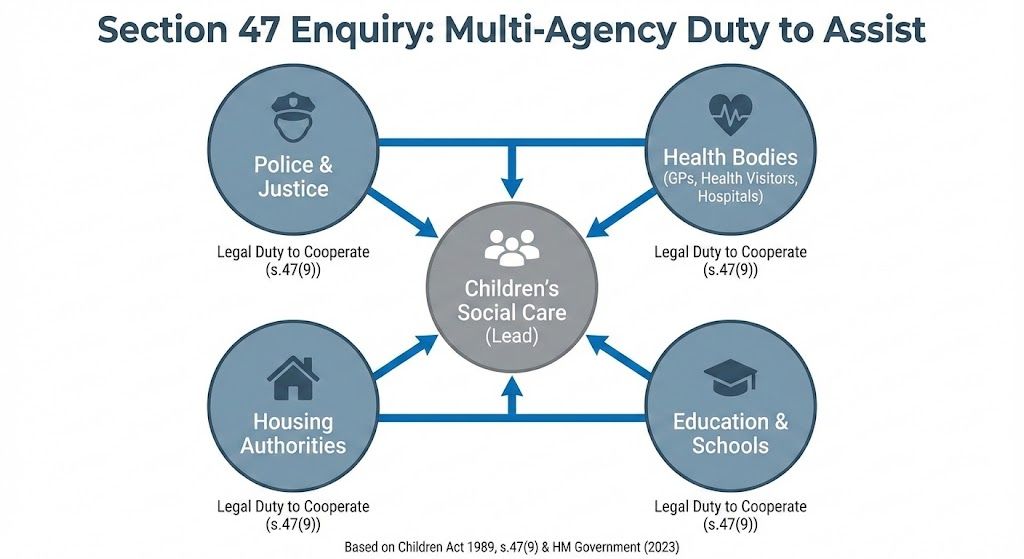
Section 47(9) makes it clear: this isn't just social work's job. Other organisations, including health bodies, housing authorities, and the police, have a legal duty to assist with the enquiry. The police also have their own role to play in investigating any potential criminal offences.
How Are Decisions About Removal Made?
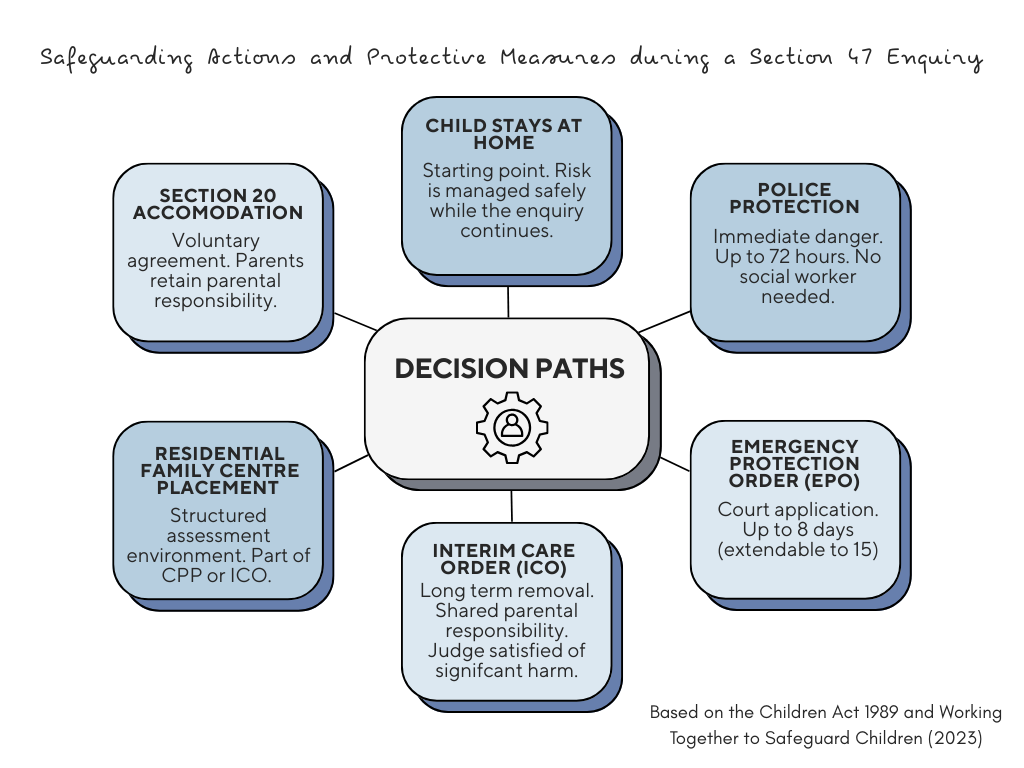
These decisions are made during the initial strategy discussion, based on the level of risk identified.
- Child stays at home. The starting point whenever possible. If risk can be managed safely, the child remains at home while the Section 47 enquiry continues.
- Police Protection (Section 46). Used in immediate danger when there's no time to reach court. Police can remove a child for up to 72 hours, even without a social worker present.
- Emergency Protection Order (EPO). The local authority applies to court for an EPO, allowing removal for up to eight days, extendable to 15 days.
- Interim Care Order (ICO). For longer-term removal, the local authority applies for an ICO. This grants shared parental responsibility and lets the local authority decide where the child lives while assessments continue. A judge must be satisfied the child is at risk of significant harm.
- Residential family centre placement. A placement may follow a Section 47 investigation, either as part of a Child Protection Plan or under an ICO. The centre provides a structured environment for assessment, with reports feeding back into the legal process and staff potentially acting as expert witnesses. Ultimately, the judge decides the final outcome.
- Section 20 accommodation. Some parents agree to placement voluntarily under Section 20 of the Children’s Act 1989, retaining parental responsibility. In practice, this comes with pressure: withdrawing consent would likely trigger an immediate court application for an ICO.
The bottom line: A child can only be removed with a court order (EPO or ICO) or by police using emergency powers. Not every Section 47 investigation leads to removal; the aim is always to work with families where possible.
What Happens Next? Outcomes of a Section 47 Enquiry
Once the enquiries are complete, the findings are analysed. There are two main paths:
- Concerns not substantiated. If there's no evidence of significant harm, the case may be closed or referred for family support under Section 17 as a Child in Need.
- Concerns substantiated. If the child is found to be at risk of significant harm, the social worker must convene an Initial Child Protection Conference (ICPC) within 15 working days of the strategy discussion.
The Child Protection Plan
The conference brings together family members, the child (where appropriate), and all relevant professionals. Their task is to decide whether a Child Protection Plan is needed.
If a plan is agreed, it becomes a living document that outlines:
- The risks and how they'll be managed.
- The actions needed to protect the child.
- Who is responsible for what, and by when.
- How progress will be reviewed.

A Final Word
Section 47 is where the state's power to intervene meets its duty to protect. Every strategy discussion, every assessment, every report written feeds into a single question: what does this child need to be safe? The answer may be support at home, a formal protection plan, or removal into care. There are rarely clean outcomes.
Children will carry the weight of whatever happens next, whether that's remaining in a difficult home environment or the trauma of separation from birth parents. Professionals carry this too. They know that for many parents, the system has already failed them long before this investigation began. But their role, at this moment, is to find the least harmful path forward, guided by the law and the evidence, knowing that the child's welfare must come first.
Sources
- Children Act 1989, s. 17 (n.d.). Legislation.gov.uk. Retrieved February 24, 2026, from https://www.legislation.gov.uk/ukpga/1989/41/section/17
- Children Act 1989, s. 47. (n.d.). Legislation.gov.uk. Retrieved February 24, 2026, from https://www.legislation.gov.uk/ukpga/1989/41/section/47
- Child Law Advice. (2024, August 8). Child protection conference and plan. Coram Children's Legal Centre. Retrieved February 24, 2026, from https://childlawadvice.org.uk/information-pages/child-protection-case-conference-and-child-protection-plans/
- Cornwall & Isles of Scilly Safeguarding Children Partnership. (2025, October 2). *Child protection enquiries - Section 47 Children Act 1989*. Retrieved February 24, 2026, from https://swcpp-cornwallscilly.trixonline.co.uk/chapter/child-protection-enquiries-section-47-children-act-198
- Darlington Borough Council. (n.d.). 4. Outcomes of a Section 47 enquiry. Darlington Children's Services Procedures Manual. Retrieved February 24, 2026, from https://www.proceduresonline.com/darlington/cs/p_sec_47_enq.html
- Department for Education. (2023). Working together to safeguard children 2023: Statutory guidance. GOV.UK. Retrieved February 24, 2026, from https://assets.publishing.service.gov.uk/media/6849a7b67cba25f610c7db3f/Working_together_to_safeguard_children_2023_-_statutory_guidance.pdf
- Family Rights Group. (n.d.). Initial Child Protection Conference. Retrieved February 24, 2026, from https://frg.org.uk/get-help-and-advice/what/child-protection/initial-child-protection-conference/
- Leeds City Council. (n.d.). One minute guide: Police powers of protection. Retrieved February 24, 2026, from https://www.leeds.gov.uk/one-minute-guides/police-powers-of-protection
- London Safeguarding Children Partnership. (n.d.). CP3. Child protection s47 enquiries. London Safeguarding Children Procedures. Retrieved February 24, 2026, from https://www.londonsafeguardingchildrenprocedures.co.uk/chi_prot_enq.html
- NSPCC. (2024, April 9). Child protection system in England: Child protection measures. NSPCC Learning. Retrieved February 24, 2026, from https://learning.nspcc.org.uk/child-protection-system/england
- Oldham Council. (n.d.). Protection orders. Retrieved February 24, 2026, from https://www.oldham.gov.uk/info/200386/protecting_children/622/protection_orders
- Sefton Safeguarding Children Partnership. (n.d.). 7.4 The Child Protection Plan. Sefton Safeguarding Children Partnership Procedures Manual. Retrieved February 24, 2026, from https://seftonscp.procedures.org.uk/skyopy/the-child-protection-plan/the-child-protection-plan