



Social CareWhat is a Family Assessment?

· 11 min read
"Family assessment" is a broad term that can mean a number of different things. This guide covers the six main types of assessment in England, their legal frameworks, and the rights every family should know.
The words "family assessment" can feel deceptively simple.
For a couple hoping to become foster carers, it marks the beginning of a long journey toward approval. For a mother in a residential centre, it means 24‑hour observation of her interactions with her baby. For a grandparent suddenly raising a grandchild, it involves visits from a social worker to determine if they can provide a safe home.
While each situation can be classified as a "family assessment," the experiences and legal frameworks could hardly be more different. The process depends entirely on why a family has come to the attention of professionals and what decision hangs in the balance.
It is easy to confuse the general term "family assessment" with the specific "Child and Family (C&F) Assessment." While "family assessment" is a broad umbrella term, a Child and Family Assessment is a formal statutory process. It evaluates a child’s needs alongside the ability of their parents or carers to meet those needs within their community.
Key Takeaways
- Not all "family assessments" are the same. They range from 45-day statutory assessments to 6-month fostering assessments, 12-week kinship checks, and residential family centre placements lasting 12–14 weeks.
- The Children Act 1989 is the legal foundation in England. Section 17 covers Child in Need assessments (voluntary support) and Section 47 covers child protection enquiries (compulsory).
- The term "Child and Family Assessment" has a specific meaning. It refers to the formal statutory process used across every local authority in England, not the general umbrella term.
- Who carries them out varies by type. Qualified social workers lead statutory and child protection assessments; fostering assessments use dedicated assessors; CAFCASS handles private law Section 7 reports.
- Families have rights throughout. They are entitled to information about the process, access to reports about them, independent advocacy in certain circumstances, and a formal complaints procedure if they disagree with findings.

The Legal Foundation: The Children Act 1989
Before exploring the different types of assessment in greater depth, it helps to understand the legal shorthand that governs most of them.
- Section 17, Children Act 1989: A "Child in Need" assessment. The child is not at immediate risk, but without support their development may be impaired. A "child in need" is defined as a child unlikely to achieve a reasonable standard of health or development without services, whose development would be significantly impaired without them, or who is disabled. These assessments are voluntary and focus on providing support.
- Section 47, Children Act 1989: A child protection enquiry. This is triggered when there is reasonable cause to suspect the child is suffering or likely to suffer significant harm. These enquiries are compulsory and parental consent is not required.
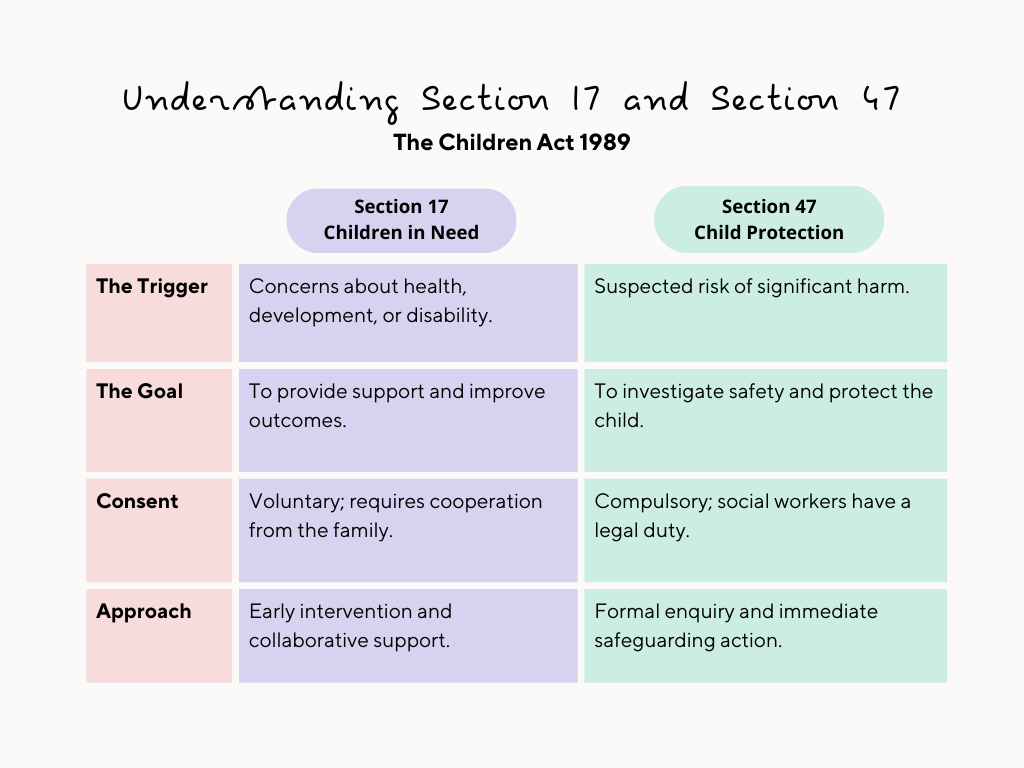
Most statutory family assessments operate under one of these two sections, and the threshold determines how thorough the assessment can be.
Different Types of Family Assessment in the UK
1. Statutory Child and Family Assessment (Local Authority)
What it is: When a referral is made to children's services, a qualified social worker initiates a multi-agency assessment under Section 17 or Section 47 of the Children Act 1989.
Who carries it out: For child protection enquiries under Section 47, the lead practitioner must be a social worker.
What it involves:
- Speaking with the child alone where appropriate, and with family members including parents and wider family
- Working directly with parents to understand their perspective, circumstances and capacity to meet the child's needs
- Gathering information from teachers, health visitors, police and other professionals involved with the family
- Drawing together and analysing available information from all sources
- Considering family history including domestic violence, substance misuse, mental illness and criminal convictions
Timeline: Assessments must be completed within a maximum of 45 working days of the date of referral to children's social care. Any extension must be authorised by a first line manager, with reasons recorded.
Possible outcomes:
- No further action, or signposting to other services
- Referral for early help services
- Provision of Child in Need services under a Child in Need Plan
- Strategy Discussion and Section 47 Enquiry if child protection concerns emerge
- Emergency action to protect a child

2. Pre-Birth Assessment
What it is: An assessment of an unborn child where there are concerns the baby may be at risk after birth. A statutory pre-birth assessment is required when specific criteria are met, such as where a previous child has been removed through care proceedings, where there are significant concerns about parenting capacity, or where the expectant parent is under 16.
Who carries it out: A qualified social worker, working alongside midwives, health visitors, substance misuse services, mental health services and other relevant professionals.
What it involves:
- Working directly with both parents (where possible) to understand their circumstances and capacity to meet the unborn child's needs
- Assessing family history, parents' relationships, wider support networks and home environment
- Evaluating the impact of parental vulnerabilities including mental health, learning disabilities, substance misuse and domestic abuse
- Gathering information from health professionals, police, previous local authorities and other agencies
Timeline: A pre-birth assessment should usually begin as soon as possible after a viable pregnancy is confirmed and the mother has registered for midwifery care, and no later than 16 weeks into the pregnancy.
Why it matters: Pre-birth assessments are essential for planning the baby's arrival. Where concerns exist, a Family Group Conference should be arranged to explore whether family or friends can provide support or care for the child.

3. Fostering Assessment (Form F)
What it is: An assessment of an applicant's suitability to become a foster carer. Unlike a statutory child and family assessment, this assesses the carer rather than a specific child.
Who carries it out: An assessing social worker employed by the fostering service or local authority.
What it involves:
- Approximately 4 to 6 months of assessment visits
- DBS checks, medical checks, employment checks and personal references
- "Skills to Foster" training
- Home safety assessment, including requirement of a spare bedroom
- Exploration of the applicant's childhood, relationships, parenting style and motivation
- A Form F report presented to an independent fostering panel
Key distinction: The child is not yet identified. The question is whether this adult has the capacity, resilience and environment to foster a child who may have experienced trauma.

4. Kinship Care Assessment
What it is: An assessment of a family member or friend who is caring for a child that cannot remain with their parents. This may lead to different legal arrangements, including Special Guardianship Orders, depending on the circumstances.
Who carries it out: A local authority assessing social worker, often from a dedicated Family and Friends or Kinship team.
What it involves:
- Viability assessment: A short assessment undertaken to determine immediate suitability, usually within a few weeks.
- Comprehensive assessment: A full assessment including mandatory statutory checks, building a profile of the adult through meetings, understanding their ability to meet the child's needs and determining their support network.
The panel process: The kinship assessment is presented to a Kinship Panel, where an Independent Review Officer reviews the assessment and determines approval.
Legal framework: Children who were previously looked after have an automatic right to an assessment for special guardianship support services.

5. Residential Family Centre Assessment
What it is: A single parent or couple, and usually a baby or young child, are accommodated in a residential centre specifically for the purpose of assessment. The family lives on site and parenting is observed by professionals.
Who carries it out: Specialist social workers and support staff employed by the residential centre, commissioned by the local authority.
What it involves:
- 12 to 14 weeks typically, though often longer in practice
- Structured observation of feeding, nappy changing, bedtime routines and parent-child interaction
- Parenting and personal development support, often called direct work
- CCTV monitoring in many centres
- Daily recording and weekly review meetings
The context: Ofsted inspects residential family centres under the Social Care Common Inspection Framework, focusing on the things that matter most to children's lives, how well families are safeguarded and how leadership reviews and improves the effectiveness of activities.

6. Private Law Assessments: Section 7 Reports
What it is: A welfare report ordered by the family court in private law proceedings, typically concerning child arrangements disputes between separated parents.
Who carries it out: A CAFCASS Family Court Adviser, or a local authority social worker if the family is already known to children's services.
What it involves: Interviews with both parents, meeting the child to understand their wishes and feelings, background checks, and a written report with recommendations to the court.
Key distinction: Unlike statutory assessments, Section 7 reports don't involve Section 47 investigative powers. The court isn't bound by the recommendations, this is advisory evidence for the judge's decision.

What They All Have in Common
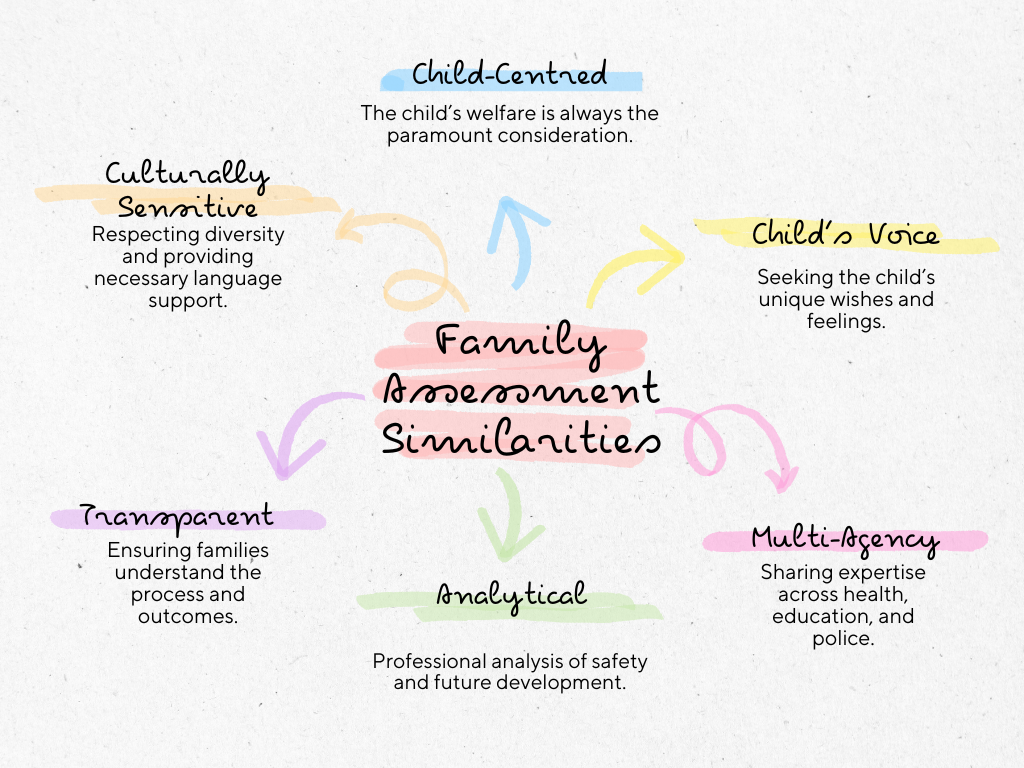
Despite this variety, every family assessment shares core principles drawn from statutory guidance:
- Child-centred: The child's welfare is the paramount consideration. Decisions should be made in the child's best interests, rooted in child development and informed by evidence.
- Informed by the child's views: Their wishes and feelings must be sought. Where possible, children should be seen alone. Observation is particularly important for babies and non-verbal children.
- Multi-agency: No single professional holds all the answers. Information should be drawn from health, education and other professionals involved with the family.
- Analytical, not descriptive: Gathering information is not enough; the assessor must analyse what it means for the child's safety and development.
- Transparent: Families should understand the process and, with limited exceptions, know what is said about them. They should be provided with written information about the assessment and its outcome.
- Culturally sensitive: When a parent or child is not a fluent English speaker, it is necessary to use an approved interpreting service to ensure full participation in the assessment process.
Families' Rights During Assessment
Regardless of assessment type, families have key rights:
- Right to information: Written explanation of the process, timescales, and possible outcomes at the outset
- Access to reports: Generally the right to see what's written about them (with limited exceptions for safeguarding)
- Right to be heard: Your perspective should be recorded and considered
- Advocacy: Children in care, care leavers, and those on protection plans are entitled to an independent advocate; all children can access advocacy for complaints
- Complaints: Every local authority has a statutory complaints procedure, this is the route to challenge findings you disagree with
Conclusion
As we have explored, "family assessment" can describe a variety of processes, each shaped by specific laws, unique timelines, and distinct questions.
Whether it is a foster carer completing a Form F, a mother in a residential centre, or a grandparent opening their home, each is undergoing a "family assessment." Though their experiences vary, the central question remains: what does this child need, and who is best placed to provide it?
Regardless of the legal threshold, voluntary support under Section 17 or an enquiry under Section 47, the process relies on evidence rather than assumptions. By involving teachers, doctors, and health visitors, the system ensures that no single professional carries the weight of these life-changing decisions alone.
For families, identifying the specific type of assessment is the first step in understanding their rights and what comes next. Ultimately, every assessment shares one primary purpose: ensuring a child is safe, loved, and supported.
Sources
- Child Law Advice. (2024, August 8). Children's services referral and assessment - childlawadvice.org.uk. Retrieved February 13, 2026, from https://childlawadvice.org.uk/information-pages/child-protection-referral-assessments-and-outcomes/
- Dudley Metropolitan Borough Council. (n.d.). What is a Child in Need Plan? A guide for parents and carers. Retrieved February 13, 2026, from https://proceduresonline.com/trixcms1/media/11335/child-in-need-guide-for-parents-and-carers.pdf
- Family Rights Group. (2025a, June 17). Kinship Assessment Guide home page with detailed contents list - Family Rights Group. Retrieved February 13, 2026, from https://frg.org.uk/policy-and-campaigns/kinship-care/kinship-assessment-guide-home/
- Family Rights Group. (2025b, November 26). What is a Family Group Conference? - Family Rights Group. Retrieved February 13, 2026, from https://frg.org.uk/family-group-conferences/what-is-a-family-group-conference/
- Government Digital Service. (n.d.). Becoming a foster parent in England. GOV.UK. Retrieved February 13, 2026, from https://www.gov.uk/becoming-foster-parent/your-fostering-assessment
- Hertfordshire Children's Services. (2025, February 19). Child and family assessments. Hertfordshire Children's Social Care Policies and Procedures Manual. Retrieved February 13, 2026, from https://hertschildcare.trixonline.co.uk/chapter/child-and-family-assessments
- Kinship charity. (2025, November 11). Special guardianship orders - Kinship. Kinship. Retrieved February 13, 2026, from https://kinship.org.uk/support-and-advice/advice-and-information/special-guardianship-orders/
- Newcastle Children's Social Care. (n.d.). Child & Family Assessment Information for parents, carers and families. Retrieved February 13, 2026, from https://proceduresonline.com/trixcms2/media/22918/cf-assessment-leaflet.pdf
- Oxfordshire Safeguarding Children Board. (n.d.). Pre-Birth assessment practice guidance. Retrieved February 13, 2026, from https://www.oscp.org.uk/wp-content/uploads/2024/02/Pre-Birth-Practice-Guidance.pdf
- Participation, E. (n.d.). Children Act 1989. Legislation.gov.uk. Retrieved February 13, 2026, from https://www.legislation.gov.uk/ukpga/1989/41/contents
- Participation, E. (2025, September 1). Children Act 1989. Legislation.gov.uk. Retrieved February 13, 2026, from https://www.legislation.gov.uk/ukpga/1989/41/section/47
- Social care common inspection framework (SCCIF): residential family centres. (2025, April 4). GOV.UK. Retrieved February 13, 2026, from https://www.gov.uk/government/publications/social-care-common-inspection-framework-sccif-residential-family-centres/social-care-common-inspection-framework-sccif-residential-family-centres
- Stanley, Y. (2025, September 3). Finding out more about residential family centres. Retrieved February 13, 2026, from https://socialcareinspection.blog.gov.uk/2025/09/03/finding-out-more-about-residential-family-centres/
- The Fostering Network. (n.d.). The Skills to Foster Training | The Fostering Network. Retrieved February 13, 2026, from https://www.thefosteringnetwork.org.uk/learning-and-development/the-skills-to-foster/