



Family Axis SoftwareData Security and Compliance for Residential Family Centres
· 8 min read
Want to build greater trust through demonstrable data security? This article outlines the key compliance requirements for residential family centres and explains how FamilyAxis is designed to help you meet them.
Data protection in residential family centres represents a critical balancing act. Professionals in this sector manage a profound responsibility: building detailed, sensitive records to support vulnerable families, while ensuring that information is rigorously protected from misuse. In 2026, this work is framed by a rigorous and evolving legal landscape, spanning from the UK GDPR to the newly implemented Data (Use and Access) Act (DUAA) 2025.
The core challenge for centres is operational: enabling swift, secure information sharing for safeguarding purposes, while maintaining airtight security against unauthorised access. Guidance from the Information Commissioner’s Office (ICO) reinforces that data protection law is designed to enable this vital work, not hinder it, provided appropriate technical and organisational measures are in place.
This article examines the current regulatory framework and details how FamilyAxis is engineered to provide the secure, compliant foundation necessary for this sensitive work. We will outline our approach to combining robust security measures with a understanding of sector-specific law, an approach designed to allow centres to focus on their primary mission of supporting families.

Key Takeaways
- GDPR empowers safe information sharing: Properly handled data lets you safeguard children without fear of violating privacy rules.
- Encrypt data in transit and at rest: Strong encryption is a baseline expectation under GDPR to protect sensitive files.
- Use Multi-Factor Authentication (MFA): Mandatory MFA for high-risk actions meets GDPR’s “appropriate security” standard and stops account takeovers.
- Enforce Role-Based Access: Staff should only see the data they need for their specific role.
Why GDPR Matters in Residential Family Centres
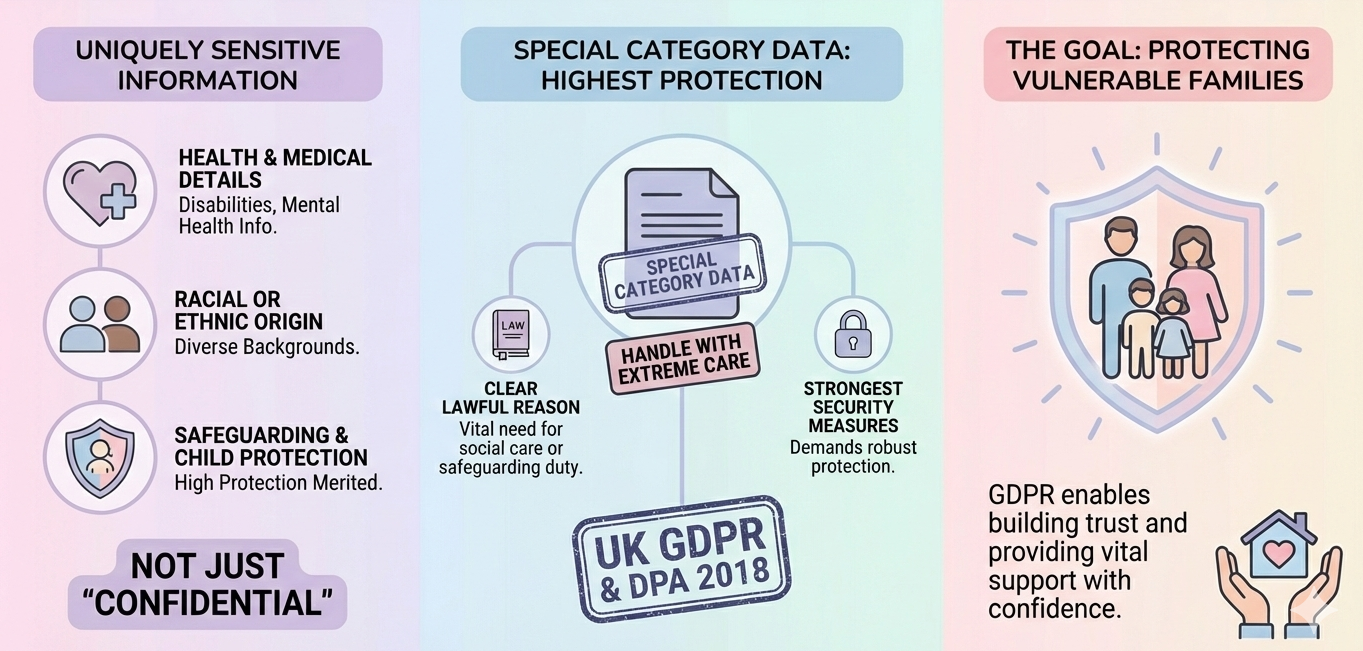
In residential family centres, the information handled is uniquely sensitive. Such as:
- Health and medical details, including disabilities and mental health information.
- Racial or ethnic origin.
- Safeguarding and child protection matters, which, while not a "special category" itself, involves data that merits high protection.
This isn't just "confidential." Under the UK GDPR and Data Protection Act 2018, this type of information is classified as ‘Special Category Data’—a legal term that puts it in the highest tier of protection.
Think of it as the "handle with extreme care" label for personal information. Processing it requires a clear, lawful reason, such as the vital need to provide social care or fulfil a safeguarding duty, and it demands the strongest security measures.
Children's Data: A Double Layer of Care
The law affords children's data an added layer of protection. Since a child often cannot provide meaningful consent, the responsibility shifts squarely to the centre to ensure data is processed in the child's best interests. This necessitates clear transparency with families, using data strictly for legitimate, specific purposes, and anchoring the process in robust lawful bases such as statutory safeguarding duties. This approach is fundamental to building trust with families from the outset.
GDPR: A Safeguarding Tool, Not a Barrier
A common fear is that data protection laws "tie your hands" in an emergency. The Information Commissioner's Office (ICO) is clear: this is a misconception. GDPR is not a barrier to sharing information to protect someone from harm. In fact, having clear, compliant policies and secure systems like FamilyAxis enables safer sharing. It ensures that crucial information reaches the right social worker or GP swiftly, while keeping it locked away from unauthorised eyes. Good data security is what allows professionals to act decisively and collaboratively to keep a child safe.
The Future of Data: The Data (Use and Access) Act 2025
Looking ahead, the landscape is evolving. The new Data (Use and Access) Act 2025 is the latest legislation that residential family centres need to take into consideration.
It introduces a new lawful basis for processing 'Recognised Legitimate Interests,', for specific purposes like safeguarding. This allows for greater confidence when sharing data, as you only need to demonstrate that the processing is necessary—without having to conduct the traditional, complex 'balancing test' against an individual's rights.
The Act also provides practical relief for day-to-day operations. It clarifies that when responding to Data Subject Access Requests (DSARs), you are only required to perform 'reasonable and proportionate' searches. This change is designed to save teams from the burden of exhaustive, time-consuming deep-dives into decades of archived files, allowing you to focus resources on current care.
How FamilyAxis Ensures Data Security
We understand how important data security is and have put measures in place to put your mind at rest. Here’s how we ensure compliance:
1. Locked Down, End-to-End: Encryption & Storage
Encryption protects information by turning it into unreadable code. Every piece of data in FamilyAxis is shielded with bank-grade encryption (AES-256). Whether information is travelling over the internet or stored on our servers, it’s scrambled and unreadable to anyone without the digital key.
All data is hosted in secure, UK-based data centres as standard, ensuring it remains under strong jurisdictional and physical protections.
2. Smart Access: The Right People, The Right Data
We enforce strict, role-based access controls. A professional can only access the family groups they work with, while managers have a broader view for oversight. This “need-to-know” principle is GDPR’s principle of data minimisation in action.
3. Multi-Factor Authentication (MFA)
We apply MFA specifically to protect your most sensitive account actions. While we don't require it for every login, it is mandatory for critical changes, such as updating a password or email address. This extra verification step significantly reduces the risk of account takeover without slowing down day-to-day work.
4. Monitoring, Logs & Backups
Detailed audit logs track who accessed what and when, providing a clear trail for accountability. Coupled with this, automatic, encrypted backups run daily, ensuring data can be quickly restored if needed.
5. Retention & Control
Residential family centres act as the Data Controller, bearing ultimate responsibility for how long data is kept. Under the Residential Family Centres Regulations 2002, case records must be kept for at least 15 years, and records for 'looked after' children often require 75 years.
To help you meet these long-term duties without the technical headache, FamilyAxis keeps your data stored for 10 years. For the remainder of the extended statutory lifecycle, we are actively exploring solutions to support centres.
One option we are considering is a Cold Storage Service, where files would be transitioned to a high-security, low-cost archive. We are keen to discuss this potential service with centres to understand if it would address a genuine need and be a beneficial part of our long-term partnership.
6. Responsible AI with Built-in Privacy
Our AI features are designed to reduce your paperwork, not replace your expertise. We distinguish between two types of assistance:
- The Smart Text Editor: Used for drafting sensitive case notes. To stay compliant with GDPR rules on automated processing, we maintain a strict 'Human-in-the-loop' policy. You have full control to accept, reject, or edit every suggestion before it becomes part of a permanent record .
- Weekly Digests: These are brief catch-up summaries for staff returning from leave or sickness. Because these are purely for internal alignment and are not used as evidence in parenting reports or legal proceedings, they serve as a simple efficiency tool to keep your team connected.
Our contracts ensure data is never used to train public AI models so that families' stories stay protected.

Best Practices & Tips for Staff
- Maintain Credential Security: Use strong passwords or Google single sign-on, and never share logins.
- Limit Data Access: Only access the family records you are assigned. Respect the roles and permissions in the system.
- Review AI Suggestions Carefully: If using the AI assistant, always double-check its output for accuracy. Remember, AI drafts are suggestions, not final reports.
- Lock Your Session: When away from your desk, log out of FamilyAxis or lock your computer.
- Follow Organisational Policies: Adhere to your centre’s guidance on confidentiality. If a family makes a data request, inform your Data Protection Officer (DPO)
In summary

By combining these practices with FamilyAxis’s built-in safeguards, residential family centres can use our platform confidently. Every measure is chosen to meet GDPR’s requirements and protect the families in your care. Together, strong tech and smart user habits keep data safe and help staff focus on providing support.
Sources
Legislation and Official Government Sources
- UK Parliament. (2018). Data Protection Act 2018 (as amended). legislation.gov.uk. Retrieved from https://www.legislation.gov.uk/ukpga/2018/12/contents
- UK Parliament. (2002). The Residential Family Centres Regulations 2002. legislation.gov.uk. Retrieved from https://www.legislation.gov.uk/uksi/2002/3213/contents
- UK Government. (2025, June 27). Data (Use and Access) Act 2025: data protection and privacy changes. GOV.UK.https://www.gov.uk/guidance/data-use-and-access-act-2025-data-protection-and-privacy-changes
- UK Government. (n.d.). Data protection. GOV.UK. Retrieved January 14, 2026, from https://www.gov.uk/data-protection
Information Commissioner's Office (ICO) Guidance
- Information Commissioner's Office. (n.d.). Home. Retrieved January 14, 2026, from https://ico.org.uk/
- Information Commissioner's Office. (n.d.). Children and the UK GDPR. Retrieved January 14, 2026, from https://ico.org.uk/for-organisations/uk-gdpr-guidance-and-resources/childrens-information/children-and-the-uk-gdpr/
- Information Commissioner's Office. (n.d.). How to use AI and personal data. Retrieved January 14, 2026, from https://ico.org.uk/media2/migrated/4022261/how-to-use-ai-and-personal-data.pdf
Professional Standards Guidance
Health and Care Professions Council. (2019). Guidance on confidentiality. Retrieved January 14, 2026, from https://www.hcpc-uk.org/standards/meeting-our-standards/confidentiality/guidance-on-confidentiality/introduction-to-confidentiality/
Secondary Guidance and Analysis
- General Data Protection Regulation (GDPR) – Encryption. (n.d.). GDPR.eu. Retrieved January 14, 2026, from https://gdpr-info.eu/issues/encryption/
- Policy Partners Project. (n.d.). The use of artificial intelligence in safeguarding and social care. Retrieved January 14, 2026, from https://www.policypartnersproject.co.uk/use-of-artificial-intelligence-in-safeguarding-and-social-care/
*Important Note: The changes brought in by the DUAA 2025 are being phased in between June 2025 and June 2026. When writing about specific provisions (like new rules for automated decision-making), it is good practice to note that organisations should check the exact commencement dates for each part of the law.*