



Family Axis SoftwareWhy a Five-Tier System? The Research Behind Our Grading Approach

· 7 min read
In this article, we explore the evidence behind our five-tier, RAG-compatible grading system. We present the psychometric research supporting this structure and explain how evolving our scale to align with standard social care frameworks ensures more precise, transparent, and evidence-based assessments for families.
Assessing parenting is a complex task that requires capturing nuanced, multifaceted behaviours within the unique context of each family.
To better support the reporting requirements of Local Authorities and regulatory bodies, FamilyAxis has evolved the colouring and structure of our grading system to be fully compatible with the RAG (Red, Amber, Green) framework.
This transition ensures that our data is both psychometrically sound and practically "audit-ready." This article explores the research behind the five-point scale and how our nuanced RAG approach enhances assessment precision.
Key Takeaways
- System Evolution: Refined based on feedback from practitioners to align with standard RAG reporting.
- Psychometric Precision: Research indicates that 5-point scales provide the optimal balance between data reliability and user clarity.
- Nuanced RAG Reporting: The use of "shades" (e.g., Dark Red vs Light Red) allows for immediate risk identification while maintaining clinical detail.
- Anchor-Led Grading: We manage rater bias through robust behavioural descriptors, ensuring consistency across the entire 5-point spectrum.
The General Science of Rating Scales
Extensive research in psychometrics (studying the theory and technique of measurement) has investigated the optimal design of rating scales. The consensus is that the number of scale points significantly impacts its accuracy and usefulness.
Reviews of the literature find that while 3-point scales are simple to use, they have inherent limitations in statistical reliability and their ability to discriminate between different levels of performance. Studies show that increasing the number of points above three dramatically improves both the consistency between different raters (reliability) and the scale's ability to measure what it intends to (validity). This is because with more than three options, individuals have the freedom to record nuanced differences in care, making it easier to distinguish between a minor issue and a more significant problem.
This is because with only three options, raters are often forced to cluster observations in the middle category, a phenomenon known as "central tendency bias." This can make it difficult to distinguish between a minor issue and a more significant problem, as both might be categorised under the same broad term.

The Value of a Detailed Grading Scale
The move towards more detailed assessment scales is already well-established and researched in other fields.
- GCSE Reform: The UK moved from an A* to G system to a 9 to 1 scale for GCSEs specifically to provide greater differentiation, particularly between high-achieving students. This acknowledges that finer distinctions provide more meaningful information about abilities.
- University Degrees: The UK degree classification system uses multiple tiers. These are often discussed in terms of First, Upper Second, Lower Second, and Third. These nuanced distinctions provide employers with vital information on a graduate's capabilities, with data confirming they correlate with different career outcomes. This demonstrates a long-standing recognition that important decisions require more than three grading categories.
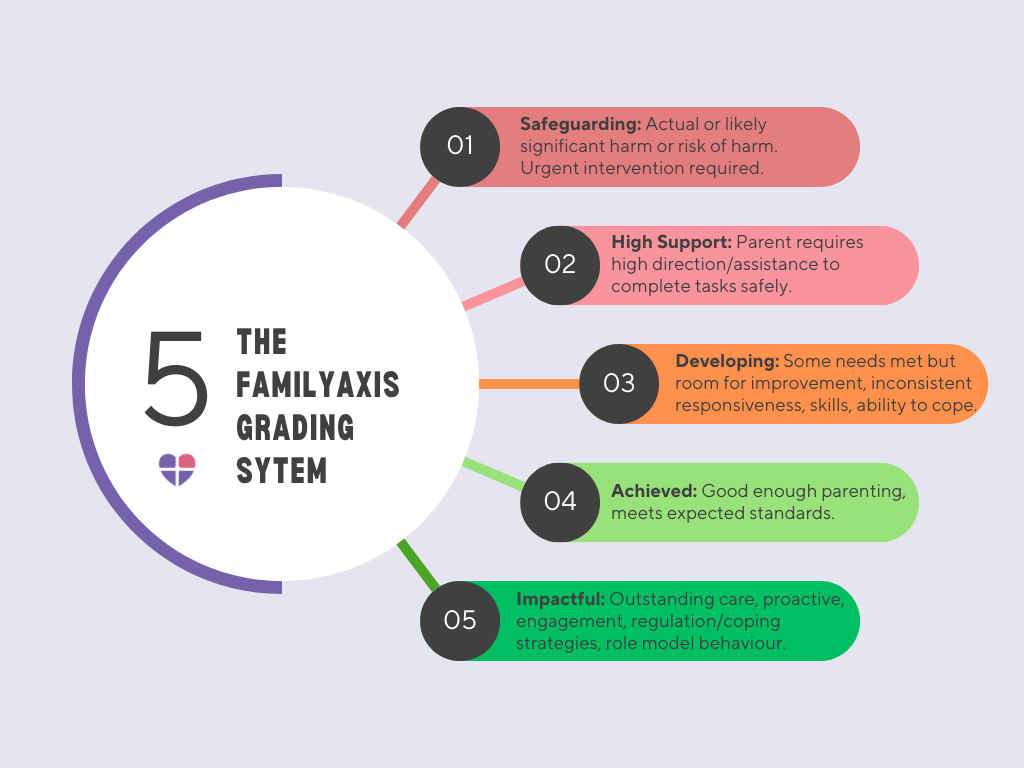
In parenting assessments, this principle is just as critical. Distinguishing between a parent who has reached the Achieved standard (competent, safe, and reliable care) and one who is Impactful (demonstrating exceptional, role-model practice) provides invaluable information.
Furthermore, this granular approach is a powerful tool for parental motivation. By breaking down the journey into smaller, more attainable steps, parents can see evidence of their progress. It is far more encouraging for a parent to see they have moved upwards from High Support to Developing, even if they have not yet reached the Achieved milestone.
This allows practitioners to celebrate small successes, which helps to maintain momentum and engagement throughout the assessment process. This approach allows practitioners to accurately evidence a family's true strengths and pinpoint the exact level and type of support required, facilitating a genuinely strengths-based approach.
The Evolution of RAG Colouring
To further support clarity for local authorities and the courts, we have evolved our colour palette. We have removed our previous blue (Foundation) colour to ensure our system is fully compatible with the Red, Amber, and Green (RAG) system commonly used within UK social care.
This alignment ensures that FamilyAxis data is consistent with the main assessment frameworks used across the sector, including ParentAssess and CUBAS. By using five tiers within a RAG structure, we can offer specific shades of Red and Green. This allows for a two-layered approach to reporting. A high-level overview might show a simple Red for a parent who is not yet independent, while the clinical record provides the necessary depth by distinguishing between Safeguarding (Dark Red) and High Support (Light Red). This ensures that the most urgent risks are visible to social workers and managers without losing the detail required for a comprehensive, professional assessment.

Benefits of the Five-Tier Grading System
Our five-level system, ranging from Safeguarding to Impactful, is designed to translate psychometric research into practical social work application. Each grade features clear behavioural descriptors which provide several key benefits:
- Improved Consistency: By giving assessors defined anchor points, we increase the likelihood that two different practitioners will grade the same observation in the same way. This reduces subjective bias and builds a more robust evidence base for the family's assessment.
- Unlocked Powerful Analytics: The granular data allows our analytics to spot subtle trends over time. A gradual improvement from High Support to Developing, or a slight decline from Impactful to Achieved, becomes visible immediately. This enables proactive support and earlier intervention, long before a more serious concern arises.
- Richer Evidence for Court: In formal proceedings, being able to present a detailed and nuanced analysis of parenting is essential. By providing specific observations mapped to a precise, RAG-compatible scale, practitioners can demonstrate a thorough and defensible level of critical analysis. This system provides a vital balance: it is clear and easy for parents to understand, which supports transparency, while providing the technical depth required for the courts and capacity recommendations.

Conclusion
Our evolution to a five-point, RAG-compatible grading scale was not made to critique existing methods, but to embrace an evidence-based standard for precision in assessment. By leveraging established psychometric research and feedback from professionals working within the sector, we have built a system that we believe is fair, reliable, and supportive for families.
At FamilyAxis, we are committed to working in partnership with the centres and professionals who are the true experts in this field. We see ourselves as an extension of your team. Our goal is to take your suggestions on board promptly so that you can continue to deliver high-quality care without the need to spend time or resources on external companies to adapt your tools.
This collaborative approach allows professionals to capture the full spectrum of parenting behaviour. It provides the detailed insights needed to craft truly individualised support plans and build the strongest possible evidence for your professional judgements.
Sources
- Balmford, G. (2025, June 25). Tips for managing biases in your social work practice. Community Care. https://www.communitycare.co.uk/2025/06/25/tips-for-managing-biases-in-your-social-work-practice/
- Casita. (2021, July 20). Explaining the UK grading system | Casita.com. Casita. https://www.casita.com/blog/explaining-uk-grading-system
- CUBAS parenting assessment. (n.d.). A guide for legal professionals. Retrieved February 26, 2026, from https://cubas.co.uk/assets/2025/03/Guide-For-Legal-Professionals.pdf
- Hoyt, W. T. (2000). Rater bias in psychological research: When is it a problem and what can we do about it? Psychological Methods, 5(1), 64–86. https://doi.org/10.1037/1082-989x.5.1.64
- Jadhav, C. (2017, August 10). Why 9 to 1? Gov.uk. Retrieved November 10, 2025, from https://ofqual.blog.gov.uk/2017/08/10/why-9-1/#:~:text=Responses%20were%20mixed%2C%20with%20some,differentiation%20at%20the%20top%20end
- Lowe, S. (n.d.). Putting it Simply | ParentAssess. Retrieved February 26, 2026, from https://parentassess.com/putting-it-simply/
- Preston, C. C., & Colman, A. M. (2000). Optimal number of response categories in rating scales: reliability, validity, discriminating power, and respondent preferences. Acta Psychologica, 104(1), 1–15. https://doi.org/10.1016/s0001-6918(99)00050-5
- Psychometrics. (2011). ScienceDirect. Retrieved November 10, 2025, from https://www.sciencedirect.com/topics/social-sciences/psychometrics
- Sauro, J., PhD. (2019, August 14). Is a Three-Point scale good enough? MeasuringU. Retrieved November 10, 2025, from https://measuringu.com/three-points/
- Sauro, J., PhD, & Lewis, J., PhD. (2020, May 20). Rating scales: Myth vs. evidence. MeasuringU. Retrieved November 10, 2025, from https://measuringu.com/ratingscales-myth-evidence/#:~:text=2,seminal%201967%20book%20Psychometric%20Theory
- Smith, M.-S. (2025). Impact of degree classification on early career outcomes. In PROSPECTS Luminate. Retrieved November 10, 2025, from https://luminate.prospects.ac.uk/impact-of-degree-classification-on-early-career-outcomes
- Statistic How To. (n.d.). Central Tendency Bias: Definition, Examples. Retrieved November 10, 2025, from https://www.statisticshowto.com/central-tendency-bias/
- Trafford Council. (2024, January 10). Common Assessment Framework. Retrieved February 26, 2026, from https://traffordcs.trixonline.co.uk/chapter/common-assessment-framework