



Social CareDisguised Compliance and Professional Curiosity in Family Assessment

· 8 min read
How can practitioners look beyond "performative" cooperation to understand a family's true reality? This article explores the 'Mindset of Curiosity', from navigating confirmation bias to ensuring that parents are heard and children remain safe.
In a Residential Family Centre (RFC), professionals undertake one of the most significant assessments in the justice system: determining whether a child can safely remain with their parents. Every observation and decision carries profound weight for the child's future.
Working within this complexity requires a disciplined blend of empathy and critical analysis. Effective practice hinges on key skills: maintaining professional curiosity to understand the family's daily reality and developing the discernment to identify complex behaviours, such as disguised compliance, that may mask underlying risk.
Effective practice holds this tension: supporting parents with empathy and avoiding shaming, while never losing the primary focus on the child's lived experience and safety. The ultimate goal is a rigorous, fair assessment that prioritises the child's best interests and supports sustainable change where possible.

Key Takeaways
- Triangulate Evidence, Never Assume: Practice "respectful uncertainty" by actively cross-referencing what is said with what is seen and what other data shows.
- Look Beyond the Performance: Shift focus from judging parental intent ("disguised compliance") to analysing the tangible impact of behaviour on the child's safety and lived experience.
- Interrogate Your Own Perspective: Actively guard against confirmation bias—both the 'rule of optimism' that minimises risk and fixed negative views that obscure progress.
- Use Supervision as Your Thinking Partner: Engage in structured reflective and group supervision as a necessary forum to challenge assumptions and maintain a child-centred focus.
The Mindset of Curiosity: "Respectful Uncertainty"
Professional curiosity involves maintaining an open, inquisitive mindset to move past initial assumptions and uncover the deeper complexities of a family's circumstances. Originally popularised as "respectful uncertainty" by Lord Laming during the Victoria Climbié inquiry, it requires a practitioner to remain "respectfully nosy," constantly seeking to understand the day-to-day reality of a child's life.
However, maintaining this level of enquiry is particularly challenging in the 24/7 monitoring environment of an RFC. In such settings, there is a heightened risk of compassion fatigue, a state of emotional exhaustion that can lead to desensitisation. When professionals become over-exposed to concerning patterns, there is a danger of "normalising" trauma, causing them to overlook genuine risks.
In this context, professional curiosity acts as a critical line of defence. By actively practicing "respectful uncertainty," staff can ensure that subtle "gut feelings" of unease are investigated rather than dismissed as routine. This disciplined curiosity is most vital when confronted with one of the most complex parental behaviours: disguised compliance.

The Complexity of "Disguised Compliance"
Disguised compliance is used to describe when parents or caregivers give the superficial appearance of cooperating with child protection plans. They may be attending meetings, agreeing to assessments, making temporary changes, while the underlying risks to the child remain unchanged or are actively concealed. The behaviour creates an illusion of progress that can mislead even experienced practitioners.
The Psychology of Interpretation
From a psychological perspective, accurately interpreting this behaviour is inherently challenging due to our "default to truth" bias, the natural human tendency to believe others to maintain social harmony. Research in safeguarding contexts reveals a sobering reality: professionals, regardless of experience, correctly identify deception only about 51% of the time, a rate equivalent to chance.
This highlights why it is crucial to understand the internal psychology behind these behaviours. What may appear as deliberate deception is frequently a trauma response. Parents who have experienced adversity or live in fear of system intervention may use survival strategies like people-pleasing, perfection during visits, or selective engagement. Recognising this as a potential "flight" response to a perceived threat allows for a more accurate, nuanced assessment of their capacity for sustainable change, separating the behaviour from the parent's intent.

Reforming the Language of Assessment
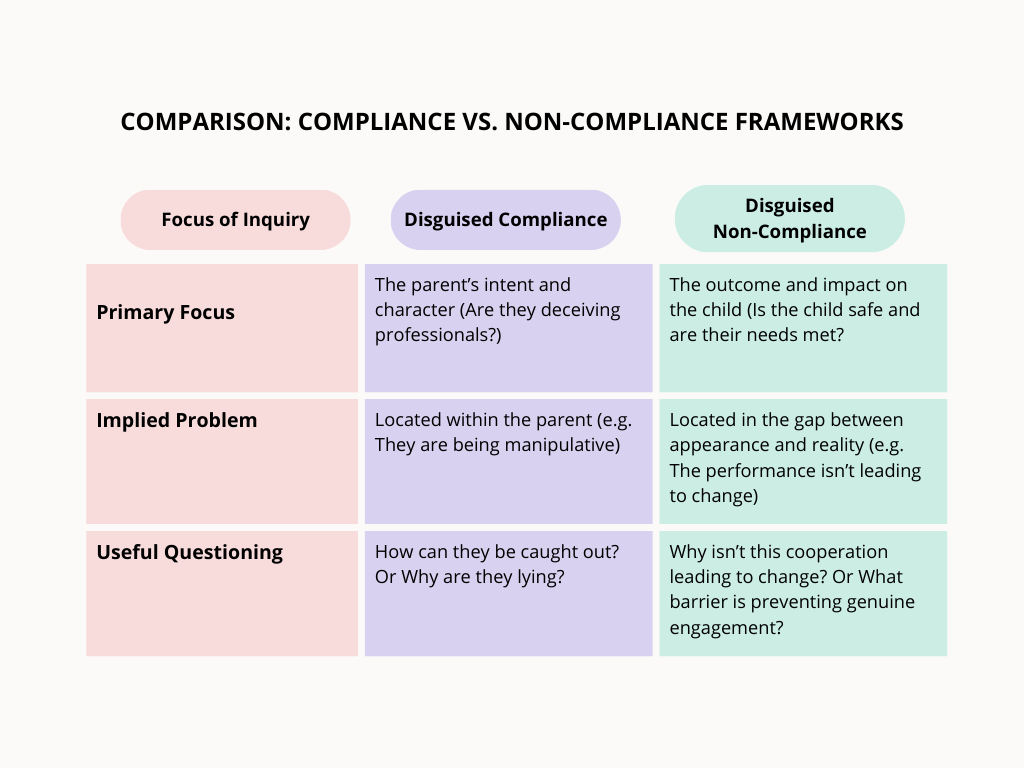
Because this behaviour is so layered, even the language we use to describe it is evolving. Some argue that the term disguised compliance is counterproductive suggesting that a more precise description is "disguised non-compliance". The logic behind this reframing is that it more accurately captures the reality: an outward performance of cooperation that masks an underlying inability or resistance to change.
While I’ll admit I find these specific terms a little confusing, what resonates is the shift in questioning this debate forces upon us. Whether we label it as "compliance" or "non-compliance," the vital step is switching from a suspicion of “Are they fooling us?” to a stance of curiosity:
“What barriers are preventing this parent from providing the safe, nurturing upbringing their child needs?”
The table below illustrates this shift in focus:
Beyond Labels: Objective Practice
Ultimately, moving beyond labels is best practice. This involves using clear, objective language that describes specific, observable actions, linking them directly to the impact on the child's safety and well-being. However, maintaining this objectivity requires constant vigilance against a fundamental flaw in human reasoning: confirmation bias.
Cognitive Barriers: The Challenge of Confirmation Bias
Confirmation bias is a universal phenomenon and perhaps the most pervasive barrier to professional curiosity.
As Nickerson (1998) define it, the concept involves:
“Unwitting selectivity in the acquisition and use of evidence … and unwitting moulding of facts to fit hypotheses or beliefs … without intending to treat evidence in a biased way or even being aware of doing so."
Essentially, confirmation bias is the natural human tendency to seek out information that validates our pre-existing views while subconsciously downplaying evidence to the contrary. In the context of family assessment, this creates a "filter" that can distort our findings in several critical ways:
- Fixed Risk Assessment: It can inhibit an accurate assessment of risk if a practitioner only looks for evidence that supports a pre-conceived conclusion, whether that view is overly sympathetic or prematurely critical.
- Anchoring to History: It can unfairly limit a parent's opportunity for change if a professional’s view remains "anchored" to past history, causing them to overlook current, tangible evidence of progress.
- Case Templating: When a family appears superficially similar to a previous case, professionals may subconsciously use that past experience as a template, failing to see the unique dynamics or strengths of the current family.
- Tunnel Vision: When a single aspect of a case dominates professional thinking, it can prevent the consideration of alternative hypotheses or the discovery of hidden protective factors.
Maintaining professional curiosity requires a conscious effort to "de-bias" our thinking. It means actively seeking out information that contradicts our current theory and remaining open to the possibility that our initial impressions might be wrong.

Counteracting Bias: The Role of Supervision
Recognising the risk of confirmation bias is only the first step; actively counteracting it requires deliberate practice and robust supportive structures. Within an RFC, the following techniques are helpful for maintaining objectivity:
- Regular Reflective Supervision: High-quality, individual supervision provides a vital "safe space" to slow down and consciously challenge assumptions. It serves as a primary opportunity to review case developments and identify the blind spots that often emerge in high-pressure environments.
- Group Case Consultation: Facilitated group supervision is invaluable for shifting stagnant thinking. By inviting a diversity of viewpoints, teams can collectively identify bias and reconsider their approach to casework from angles an individual might miss.
- Playing ‘Devil’s Advocate’: Supervisors and team members should routinely ask ‘what if?’ questions. This technique forces the consideration of alternative hypotheses and deliberately disrupts linear thinking, ensuring that no single narrative dominates the assessment.

Conclusion
Professional curiosity in a Residential Family Centre is the disciplined practice of balancing empathy for parents with an unwavering focus on the child’s safety. The goal is to move beyond judging parental intent and instead focus on a rigorous analysis of how specific behaviours impact the child. This reframes the assessment from a judgement of character into a systematic evaluation of a family’s capacity for change.
However, this focus is constantly challenged by cognitive shortcuts like confirmation bias. Whether it is a "rule of optimism" that minimises risk or a fixed negative view that ignores progress, bias systematically undermines objective curiosity. The primary defence is a culture of "respectful uncertainty," supported by structured supervision where assumptions are actively challenged and alternative hypotheses explored.
Ultimately, this disciplined inquiry allows practitioners to pierce through performative cooperation and personal bias. By committing to this level of scrutiny, professionals can achieve a clear-eyed understanding of a child’s reality, ensuring every decision is rooted in their long-term safety and well-being.
Sources
- Dickens, J., Cook, L., Cossar, J., Okpokiri, C., Taylor, J., & Garstang, J. (2023). Re-envisaging professional curiosity and challenge: Messages for child protection practice from reviews of serious cases in England. Children and Youth Services Review, 152, 107081. https://doi.org/10.1016/j.childyouth.2023.107081
- Earle, F., Fox, J., Webb, C., & Bower, S. (2017). Reflective supervision: Resource pack. In S. Flood (Ed.), Research in Practice. Retrieved January 26, 2026, from https://www.researchinpractice.org.uk/media/2d2dxwrn/reflective_supervision_resource_pack_2017.pdf
- Engaging theories in interpersonal communication (3rd ed.). (2022). Sage. Retrieved January 26, 2026, from https://books.google.co.uk/books?hl=en&lr=&id=CdhCEAAAQBAJ&oi=fnd&pg=PT376&dq=default+to+truth%22+bias+social+care&ots=L-A0NgZYyj&sig=9ZbatjOro875vG5y1HK_pNqhoOc&redir_esc=y#v=onepage&q&f=false
- Fox, L. (2020). Detecting parental deception in the child safeguarding context. Retrieved January 26, 2026, from https://pure.port.ac.uk/ws/portalfiles/portal/50955539/L_Fox_Detecting_deception.PDF
- Plymouth Safeguarding Board. (2024, April 9). Professional Desensitisation - Plymouth Safeguarding Children Partnership. Plymouth Safeguarding Children Partnership. https://plymouthscb.co.uk/professional-desensitisation/
- Simkus, J. (2023, November 10). Confirmation Bias In Psychology: Definition & Examples. Simply Psychology. https://www.simplypsychology.org/confirmation-bias.html
- Stay Safe Worcestershire. (n.d.). WSCP Professional Curiosity Briefing. Retrieved January 26, 2026, from https://www.safeguardingworcestershire.org.uk/wp-content/uploads/2024/08/WSCP-Professional-Curiosity-Briefing.pdf
- Trotter, V. P. (2022). Correlation between compassion fatigue related to secondary trauma and burnout in social workers [Dissertation, Trevecca Nazarene University]. https://www.proquest.com/openview/9cf9601cca8c0d4980c2cbf3ef2a805f/1?pq-origsite=gscholar&cbl=18750&diss=y